















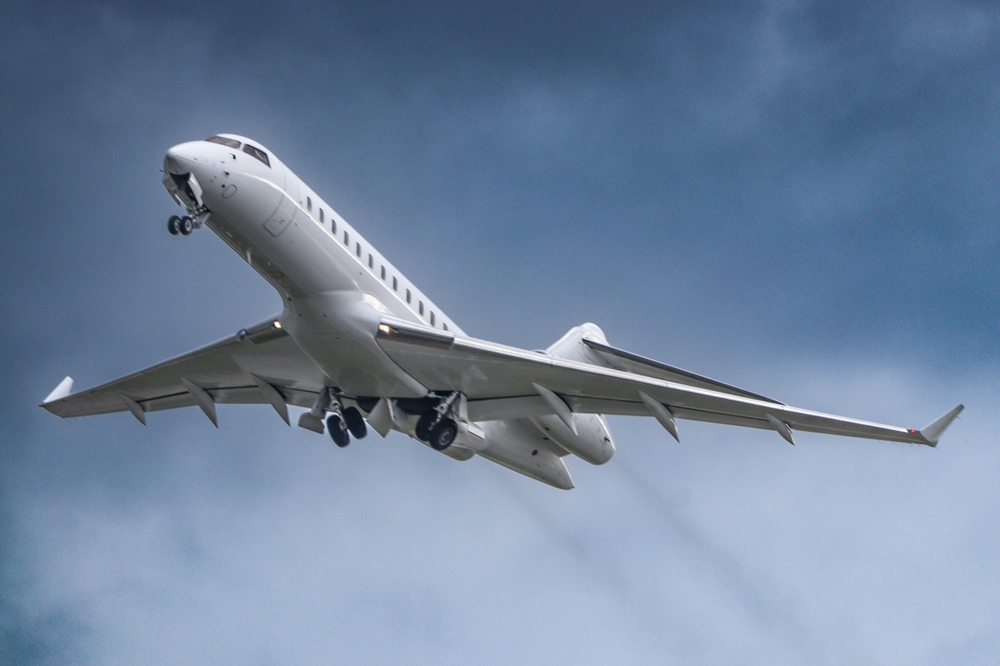

France’s Air Defense and Air Operations Command said Monday that a Rafale pilot discovered a fuel leak on a civilian Bombardier Global 6000 while the fighter was conducting an air-defense training mission. The command did not specify when the flight occurred.
The Rafale joined the civil aircraft at 40,000 feet during the exercise. The fighter pilot noticed an additional trail behind the Global 6000 that appeared different from its normal condensation trails, according to the command. After moving closer to investigate, the pilot detected the smell of jet fuel and determined that fuel was escaping from the Global’s right wing.
The Global 6000 crew was alerted to the leak and reported the situation to air traffic control. The crew had initially planned to continue toward Miami, but the aircraft subsequently diverted to Paris-Le Bourget Airport.


“After moving closer to investigate, the pilot detected the smell of jet fuel. . .”
Wow! How close did the fighter pilot have to get to smell fuel – through his canopy, his helmet, etc.?
Don’t you ever smell partially burned kerosene while in an airliner on the ground. Outside air is used in cabin pressurization, generally taking bleed air from the compressor. It would still have kerosene vapors entering the pressurized cabin environmental control system.
Hey Mars, Google sense of smell at 40,000 feet, through a canopy, wearing an O2 mask…
Granted, if you have on an oxygen mask you won’t smell it. The dispersion/vaporization arguments put forth by google don’t hold up to high concentration of hydrocarbon vapors. If they come through the system you would smell them but not if you have on a mask. The canopy and helmet don’t block air running through the pressurization and environmental control but an oxygen mask would if fully sealed on the pilot’s face.
Honest question, was the pilot on 100% O2 at the time? If not even a small amount of vapor could enter his mask and he would smell it.
Our Airline crew system will operate with some % of cabin air into the system to extend the O2 supply. The higher you go the closer to 100% and you can immediately switch to 100% O2 in the case of smoke or fumes in the cabin. I realize fighters are very different that’s why it’s an honest question.
It’s a reminder to monitor fuel consumption during the flight.