















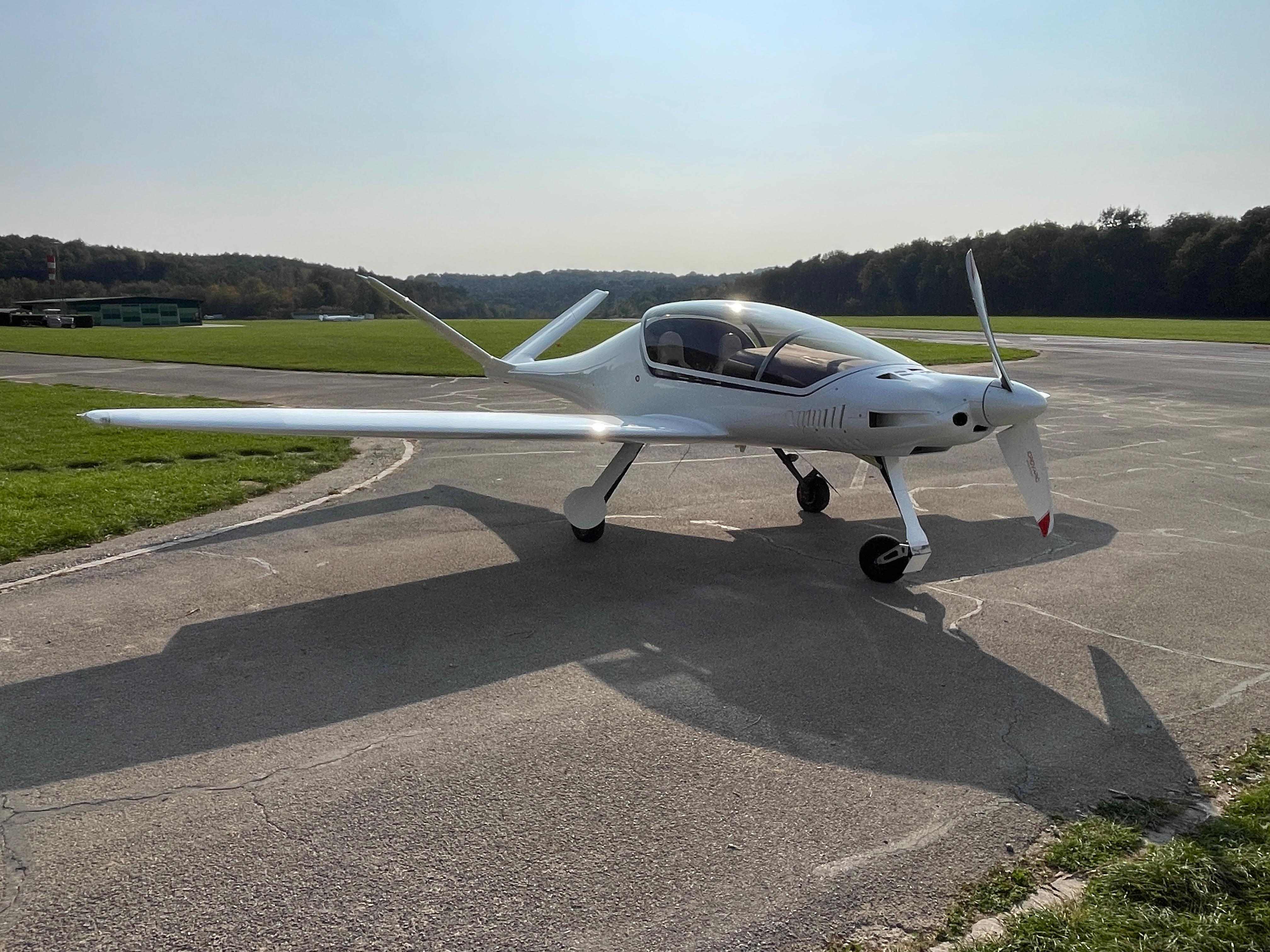

A Rotax 916-powered Porto Aviation Risen has set world records for speed over a straight course and speed over a 50-kilometer closed circuit in the two-seat RAL2T microlight class. As of Sept. 15, the Fédération Aéronautique Internationale lists both performances as ratified current world records. Pilot Alberto Rodolfo Porto flew the records Oct. 16, 2025, from Alzate Brianza Airport in northern Italy.
The straight-course run reached 453.20 km/h, or about 244.7 knots, while the 50-kilometer circuit was completed at 432.69 km/h, about 233.6 knots. FAI’s RAL2T classification covers land-based microlights flown with two people, using movable aerodynamic controls and a thermal engine.
Porto also flew a 100-kilometer closed circuit at 431.14 km/h, about 232.8 knots, during the same series of flights. That performance remains listed by FAI as a “dossier under review” and has not yet received the same ratified status. Porto Aviation announced all three attempts shortly after the flights last October.


Looking at the very exact objective of the ROTAX 916 application I wonder why the specifications do not contain also directives for the propeller to be used?
Second - as an old advocate of adaptive propeller technology - wish to remind, the achievable top speed depends not only on the power of the engine, and on the aerodynamic shape of the body of the plane. Propellers’ role is just as great.
If not greater. All traditional propellers have their very definite top speed, beyond which they just stop developing thrust. This value can be set at the design phase. Limiting factor is the well-known deterioration of the low speed and takeoff characteristics, as higher and higher design-top-speeds are picked.
Present report is very clear about the existence of a very strong desire within the aviation community to achieve higher speeds with small planes too. Can’t wait when the real key to that - the factual embracing of the adaptive propeller technology - gets widely discovered.