














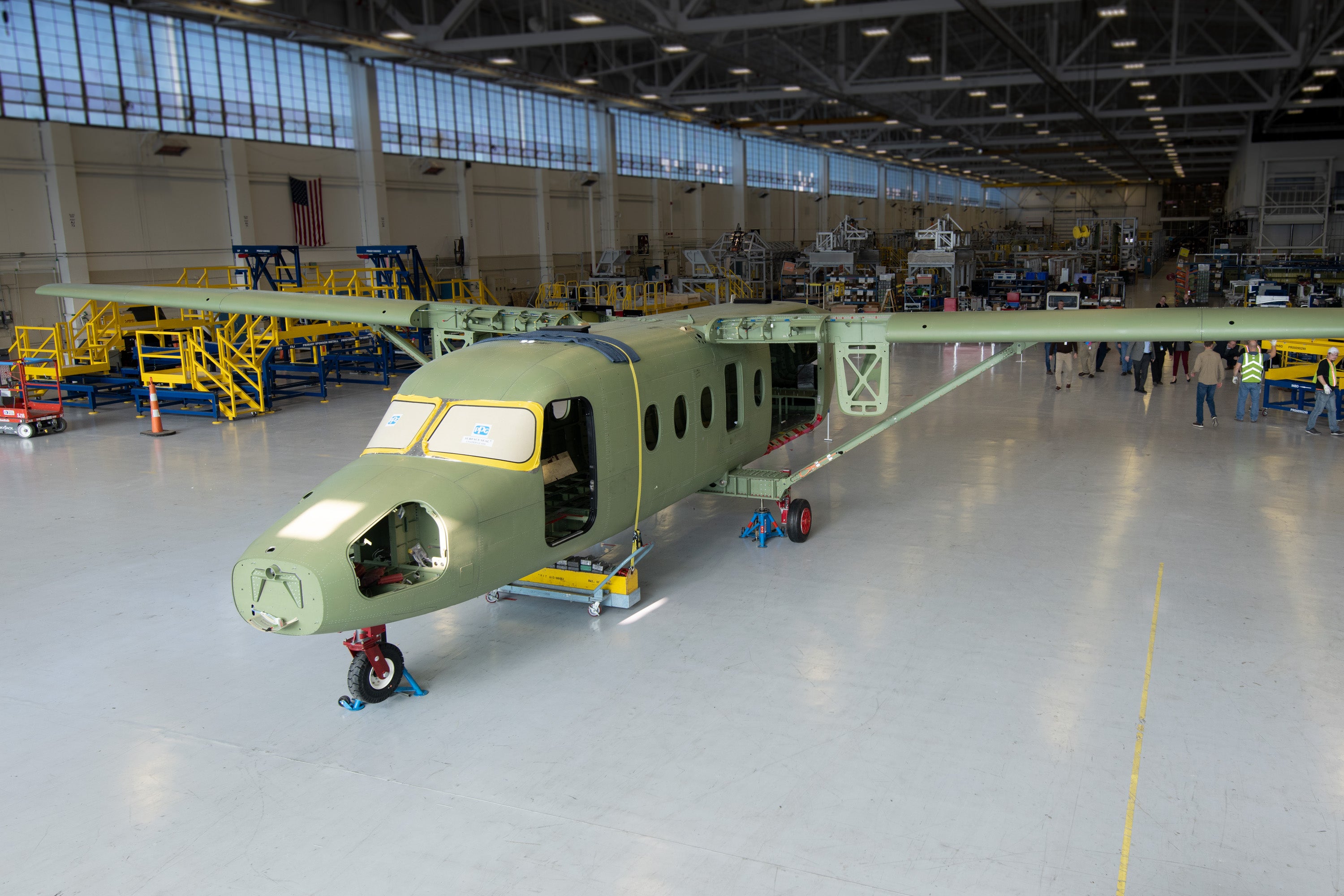

Textron Aviation announced that it has successfully attached the wings to the fuselage of its first Cessna SkyCourier prototype. According to the company, landing gear and avionics ground testing for the twin-engine utility turboprop are also underway. The first flight of SkyCourier is expected to take place in 2020.
“As expected, the operation was sound as the wings were secured on the fuselage, and the new Cessna SkyCourier took another major step in its development,” said Textron Aviation Senior Vice President for Programs and Engineering Chris Hearne. “The Cessna SkyCourier’s rugged, high-wing design will give the aircraft excellent operational and performance characteristics for its diverse mission profile.”
The Cessna SkyCourier will be equipped with the Garmin G1000 NXi avionics suite and powered by Pratt & Whitney PT6A-65SC engines. Depending on aircraft configuration, it is designed to seat up to 19 passengers or carry three standard LD3 air cargo containers. The SkyCourier has a range of 900 NM, 6,000-pound payload and maximum cruise speed of up to 200 knots.
