
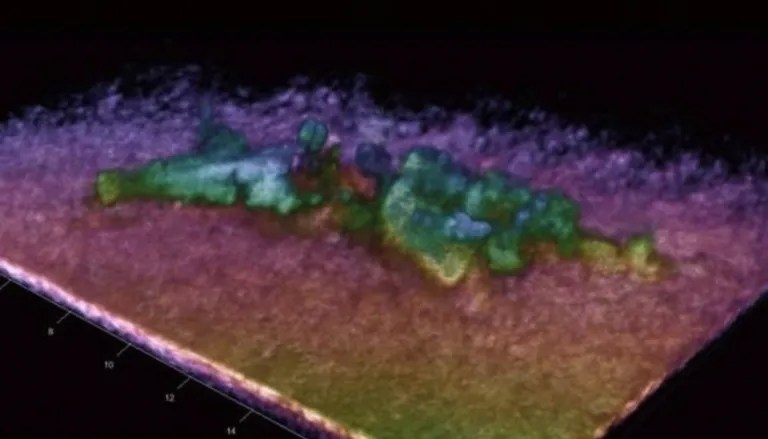

The National Transportation Safety Board (NTSB) announced earlier this week that sonar equipment has located wreckage from the float-equipped de Havilland DHC-3 Turbine Otter that crashed into Washington state’s Mutiny Bay last week. According to the NTSB spokesperson Jennifer Gabris, on Saturday, sonar located a “large section” of debris, matching the length and width of the plane. The wreckage was pinpointed some 190 feet below the surface of Puget Sound a short distance from Whidbey Island, where the aircraft took off for a short leg to Renton, Washington. The crash occurred just 18 minutes into the flight.
To date, only small portions of debris and the body of one of the 10 victims on board, 29-year-old Seattle attorney Gabrielle Hanna, have been recovered. As previously reported by AVweb, the Walter-engine-converted Otter crashed on the afternoon of Sept. 4.
The NTSB tapped the National Oceanic and Atmospheric Administration (NOAA) and the University of Washington’s Applied Physics Laboratory in searching a 1 3/4- by 3/4-mile area with side-scan and multibeam sonar and 3D instruments. The site was where up to 24 witnesses from boats and on shore reported that the plane had crashed. The search was hampered by the depth of the water and the current, reported as 3 to 5 knots.
According to the NTSB, “Due to the depth of the water and the current, the most suitable tool for recovery is a work-class remotely operated vehicle [ROV]. NTSB continues to be in communication with federal agencies and local companies to obtain a work-class ROV.”
Besides the urgency of recovering the remains of the nine still-missing victims, including pilot Jason Winters, the NTSB has cited the importance of recovering the wreckage to help determine the cause of the crash. Experts have theorized that the suddenness and steepness of the descent (estimated at up to 8,000 feet per minute) suggest structural failure of the tail.