















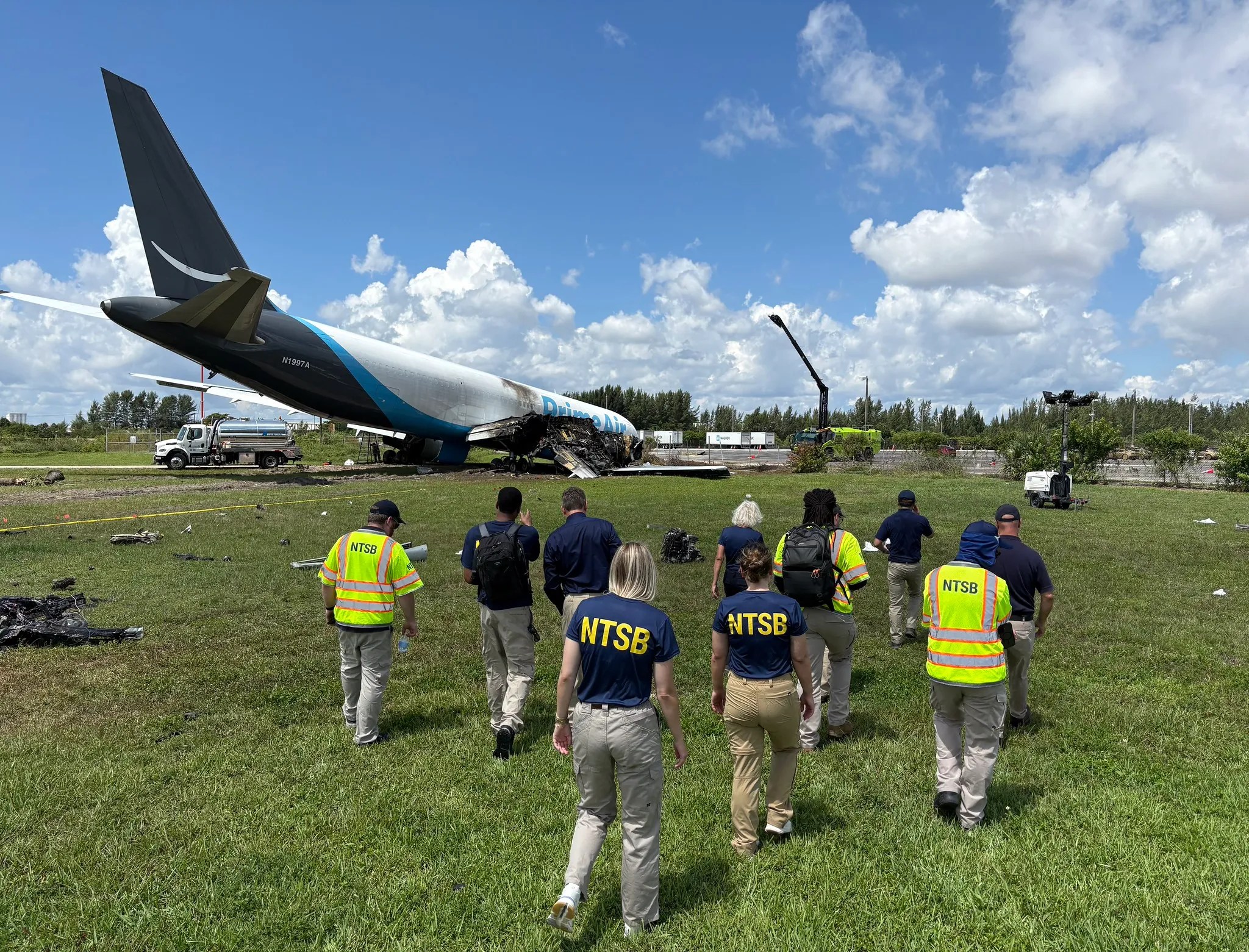

The National Transportation Safety Board released its preliminary report Thursday on the Sept. 6 accident involving an Amazon cargo aircraft at Miami International Airport. Among its findings, the report indicated that the Boeing 767 crew was not provided updated wind information before landing. The aircraft, operated by 21 Air for Amazon, touched down approximately 3,750 feet beyond the threshold of Runway 30 at a groundspeed of about 160 knots. It subsequently overran the runway and struck two vehicles, killing five people on the ground and seriously injuring three others.
Wind Information Not Provided
According to the report, thunderstorms were moving through the area around the time of the accident. Airport weather observations recorded winds from 190 degrees at 17 knots, gusting to 26 knots, near the time of landing. Approximately four minutes before clearing the cargo flight to land, the tower controller had provided another aircraft wind information indicating gusts of up to 22 knots. However, the Amazon cargo flight was operating on a different frequency at the time and did not receive that transmission.
“The LCS issued a landing clearance to flight 7598 but did not issue information about the wind,” the NTSB stated. “Per FAA Order JO 7110.65BB, titled ‘Air Traffic Control,’ both wind direction and velocity were required to be stated when authorizing use of a runway when a tailwind component exists.”
Crew Warned of Excessive Speed
Cockpit voice recordings revealed that the first officer repeatedly cautioned about excessive airspeed during the approach. The aircraft crossed the runway threshold at approximately 177 knots groundspeed before touching down. After touchdown, the crew initially applied wheel brakes but subsequently released them and advanced the throttles to settings consistent with go-around thrust.
At that point, approximately 930 feet of runway remained. The throttles were returned to idle and braking resumed seconds later, when only about 415 feet remained. Investigators found no recorded indication that the aircraft’s speed brakes or thrust reversers deployed, consistent with the NTSB’s earlier investigative update.
The aircraft departed the paved surface at approximately 113 knots and eventually came to rest about 1,200 feet beyond the runway. In a statement provided to NBC Miami, 21 Air said it was reviewing the report and would take appropriate safety measures as additional facts become available. Amazon previously suspended its relationship with the operator following the accident. The NTSB investigation remains ongoing, and investigators have not determined a probable cause.


Sure, that might somewhat contribute to the problem, but I’m sure that the crew was required to acknowledge receiving the ATIS, as well as monitoring their own ground speed over the numbers.
I see the one item that covers the situation - Not knowing the history of the speed brake. I was a B
I see the one item that covers the situation - Not knowing the history of the Bowing speed brake. Originally it was always used manually! If that had remained the Capt would have pulled it manually at the touchdown of any wheel to the runway. Instead in the automatic deployment position it never deployed because the gear squawt switches never agreed to the automatic deployment! Now see if the delay allowed engine spool down, etc.
ss
The article really is an example how bad journalism has become
Trying to spin a bias and make a huge issue out of a single minor error while ignoring multiple egregious errors.
Leading and focussing on the least relivent factor and downplaying the most relivent.
Yes ATC failed to issue a wind statement.
It does happen regularly at busy airports, but it had also given to multiple other aircraft
And that information is always available to the crew from the automated system and 3 different instruments in the aircraft easily seen.
And you ignore the 11 regulations the crew intentionally ignored requiring the abandoning of the approach and landing
Those 11 regulations the crew ignored are specifically to prevent this type of accident.
They were not simply warmed of excessive speed.
No wonder no one trusts “news” these days with such dishonest reporting
That didn’t have anything to do with it. I was a destable approach from the get-go and nobody thought that was unsusal ?
Boeing taught ‘fly the numbers’, did a study showing that greatly reduce problems.
Boeing used Pacific Western Airlines as an example - quite successful operating B737 on short runways including winter conditions. Captain Revel was a good leader as Chief Pilot.
(An article may be findable from archives of Boeing’s flight operations oriented magazine of decades ago.)
Looking at the groundspeed versus airspeed chart in the report the tailwind contributed about two to three knots to the ground speed. That is trivial and inconsequential compared to the roughly 30 knots of excessive airspeed that they had well before and just after crossing the runway threshold. They had perhaps a minute or more to see the obvious unstable approach and go around.
This was an egregiously poor approach and the outcome is 100% attributable to the two pilots.
My airline routinely flew into uncontrolled airports, so there aren’t any tower controllers to tell you anything. SOP’s are written so that certain limits must be memorized and obeyed. They not only help keep you safe, but they also keep you out of the Chief Pilot’s office having to explain yourself. It is always just easier and less hassle to follow the SOP.
Yeah, I knew this was coming. It wouldn’t have made any difference if winds were reported. It was an unstable approach all the way down until they went off the runway and a wind check would have done nothing to save that approach with a normal landing. I’m sure the lawyers will be all over this.