















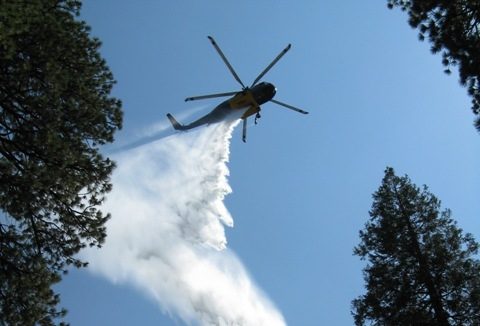

Two pilots were killed Sunday when a firefighting helicopter crashed in Yosemite National Park while supporting suppression efforts on the Dome Fire. The Eurocopter AS332L1 operated by Precision went down shortly before 3 p.m. while conducting water bucket drops southeast of Ostrander Lake. The FAA and NTSB are investigating the accident.
A National Park Service update issued Sunday morning said a temperature inversion was expected to trap smoke until late morning or early afternoon and that hazy skies would impair distant views. Winds were forecast from the southwest at 6 to 10 mph, with gusts around 15 mph on exposed ridges. The NPS had warned a day earlier that poor visibility from smoke was delaying flight operations, although it is not known at this time whether visibility played a role in the accident.
Precision Confirms Loss
“It is with unimaginable sadness and broken hearts that we share the loss of two beloved members of our team,” Precision said in a statement. “We are devastated by this loss and are struggling to find the words. We ask for privacy and compassion for their families and our team as we grieve this tremendous loss.”
The Alaska Division of Forestry and Fire Protection identified one of the pilots as Greg King, who had worked extensively on wildland fires in Alaska. The agency said the identity of the second pilot was being withheld pending family notifications.
Dome Fire
The Dome Fire began Sept. 15 near Wawona and had grown to 3,222 acres by Monday morning. The fire remained 15% contained as 581 personnel worked the incident, according to the National Park Service.
Helicopters have played a significant role in the response because crews are working in steep and remote terrain. Before the accident, aircraft assigned to the fire had been used for water drops, transportation and delivery of supplies to firefighters working away from road access.


An Aerospatiale Super Puma, used to be quite a few in North America - Okanagan/Canadian Helicopters used them to take workers to and from oil platforms off of Newfoundland.
(L means the longer Super version, identifiable by top forward fuselage projecting beyond engine inlets.)
My condolences to the pilots’ families. Aerial firefighting is a dangerous job, especially for helicopters during suppression operations in mountainous terrain. They often dip out of confined water sources with the helicopter at maximum load and power in high density altitudes. Ridgeline turbulence and severe leeward side downdrafts can be present when the wind on the ridgeline is over 15 knots. Visibility is limited in smoke on many drops and obstacles can be hidden in the smoke. Their drops are just above the trees to be effective. I flew a scout plane and worked with suppression helicopters and tankers for seven years in mountainous areas so I’ve had first-hand experience with these operations.