
















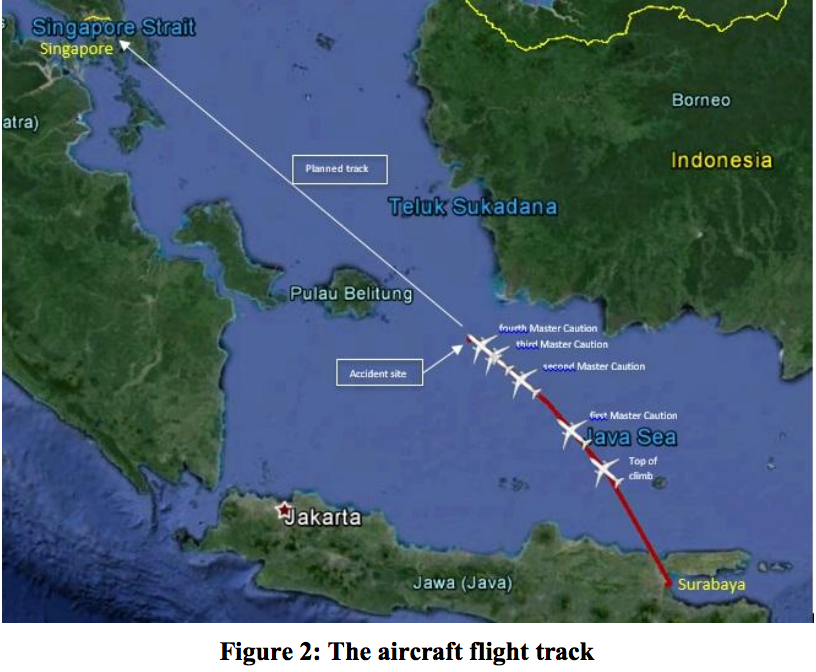
The string of incidents that led to the crash of Air Asia Flight QZ8501 on Dec. 28 last year began with a mechanical malfunction that had gone unresolved despite having failed 23 times, investigators said in their final report (PDF), issued today by Indonesia’s National Transportation Safety Committee. But in trying to cope with the malfunction, the captain issued “ambiguous commands” to the first officer, and failed to take over the controls, the report concludes. The Airbus A320 climbed to 38,500 feet, rolled 104 degrees to the left, then stalled and lost altitude at a rate of up to 20,000 feet per minute. The airplane crashed into the Java Sea, killing all 162 on board.
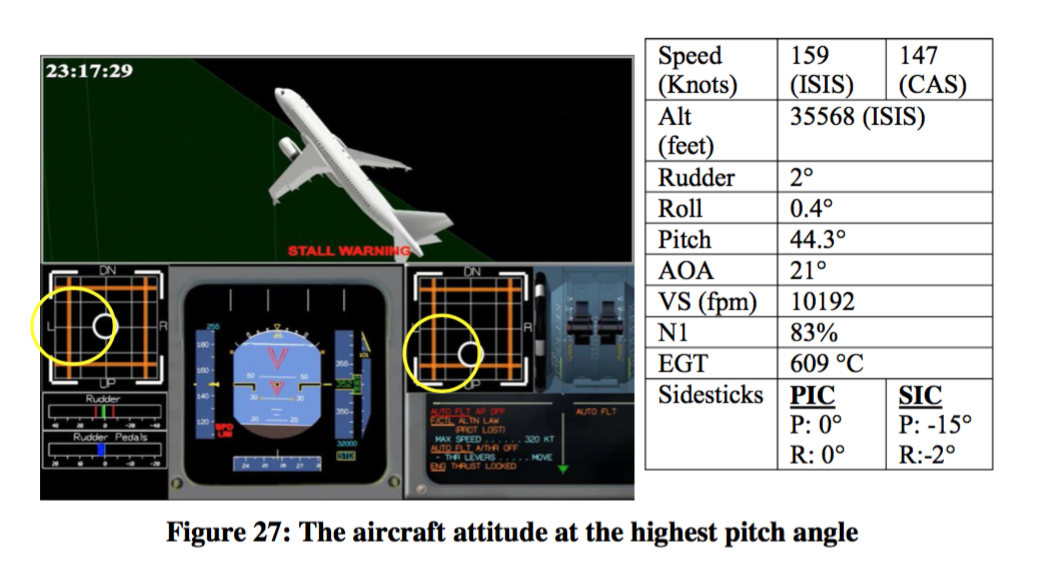
The committee found the captain was dealing with a repeated technical problem with the Rudder Travel Limiter (RTL), leaving the first officer at the flight controls. An electrical interruption to the RTL happened three times in the space of 13 minutes, eventually causing the autopilot to disengage. With the loss of the autopilot function, the first officer was flying the plane manually, and it was at that point there was a miscommunication between the two pilots, investigators said. According to the cockpit voice recorder, the captain told the first officer to “pull down,” and the first officer apparently understood that to mean he should pull back on the sidestick controller, which sent the aircraft climbing. Whenever the captain repeated the command “pull down,” the backward input on the right sidestick increased, according to the report. The pitch angle increased up to a maximum of 48 degrees.
The investigators also found that near the end of the flight data recording, both left and right sidestick input were continuously active. The right sidestick was pulled for most of this segment, and the nose-down pitching commands of the left sidestick became ineffective because of the summing function of the system, resulting in ineffective control of the aircraft. The investigators recommended that operators’ pilot training should re-emphasize the taking-over-control procedure in critical situations. Also, the report recommended that upset recovery training should be mandatory for A320 flight crews.

