

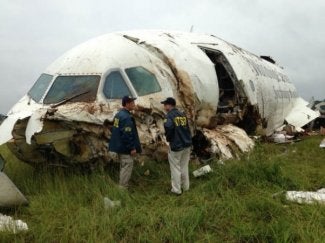
The UPS A300 that crashed in Birmingham, Ala., on Wednesday flew itself into the ground, according to the NTSB preliminary analysis of the flight data recorder information. At a news conference on Saturday NTSB spokesman Robert Sumwalt said the aircraft was flying on its autopilot until “moments” before it crashed less than a mile short of the runway at the airport about 4:45 a.m. The autopilot was engaged until the last second of recorded data, said Sumwalt.The autothrottle was also engaged.
A sink rate warning was sounded in the cockpit seven seconds before impact but Sumwalt did not outline the reaction of the crew to that warning. He said the investigators will look at UPS’s instrument approach procedures, noting that it’s common for crews to rely on the electronics to fly instrument approaches. The rest of the airplane was operating normally, he said.Authorities have now identified the pilots killed in the crash as Cera Beal Jr., 58, of Matthew, N.C., and Shanda Fanning, 37, of Lynchburg, Tenn. The pairing started their work day in Rockford, Ill., the previous day and flew to Peoria and Louisville, where they accepted keys to crew rest facilities. They left from there for the flight to Birmingham.