
















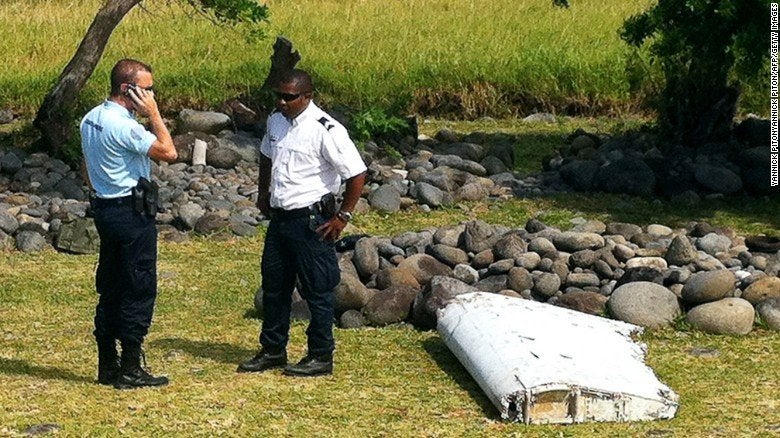
Officials have confirmed that the flaperon found on Reunion Island off the coast of Africa last week originated from Malaysia Airlines flight MH370, which vanished in March 2014. That origin for the wreckage had already been widely assumed, since it was known to be from a Boeing 777, and only one of those has been lost in the Indian Ocean. However, the statement fromMalaysian Prime Minister Najib Razak on Wednesday lent official certainty to the news.“It is with a very heavy heart that I must tell you, an international team of experts have conclusively confirmed that the aircraft debris found on Reunion is indeed from MH370,” Razak said at a brief press conference. “We now have physical evidence that … Flight MH370 tragically ended in the Southern Indian Ocean.”
The 777 vanished en route from Kuala Lumpur to Beijingwith 239 people on board. They’ve been presumed dead and in January,the Malaysian government pronounced it an accident. Further analysis of the flaperon could reveal more clues to the airliner’s fate, but to what extent remains unclear. The Wall Street Journal reports that investigators will try to determine what caused that part of the wing to break off, but there is some doubt as to whether such a small piece of the 777 can help determine the plane’s condition as it crashed into the ocean.“Establishing how it probably separated,” according to Robert Matthews, a former senior Federal Aviation Administration safety official, “is a far cry from determining what happened” to the rest of the plane, according to the Journal report. Unless there is more evidence found, the airliner’s change of course before disappearing will likely remain a mystery.“The analysis of this piece will not answer why this aircraft departed from its route,” said Jean-Paul Troadec, the former director of the French air accident investigation office, told the Journal.

