
















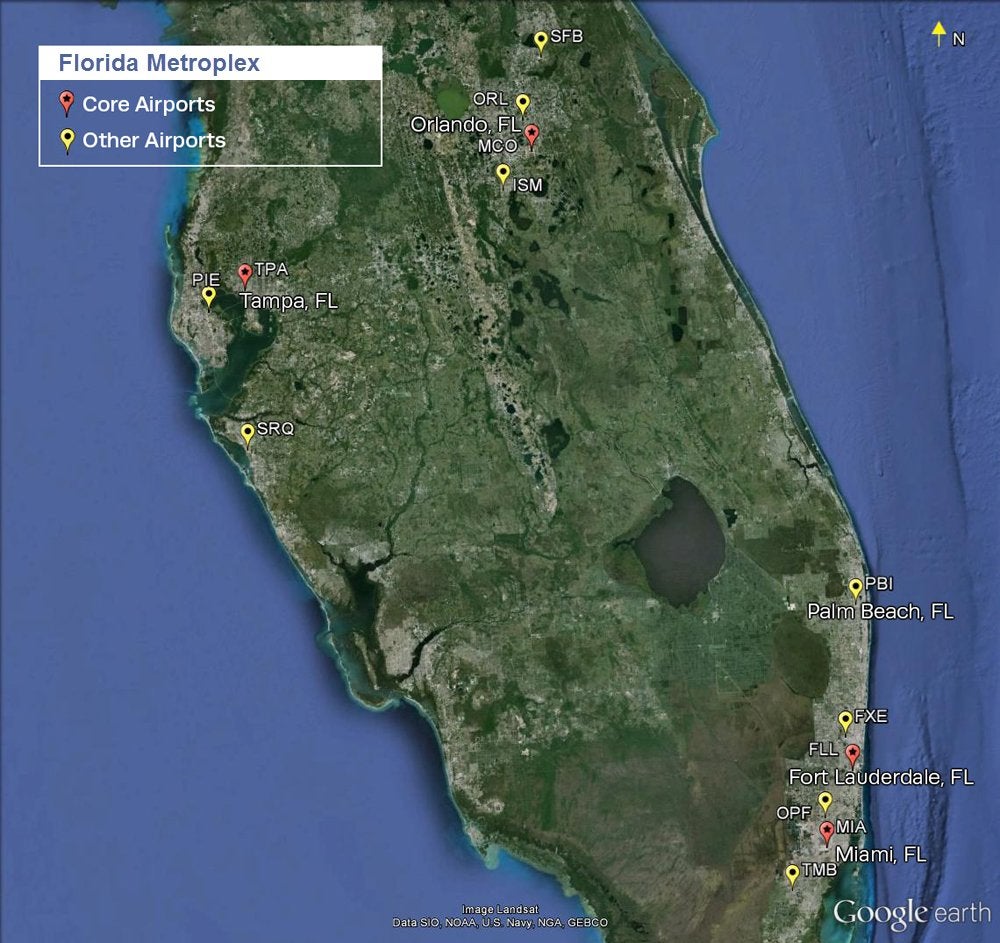
The FAA has announced that is redesigning flight paths and air traffic control procedures for aircraft flying over Central and South Florida as part of its Next Generation Air Transportation System (NextGen) airspace modernization initiative. The administration says the endeavor, called the South-Central Florida Metroplex project, will replace “dozens of existing air traffic procedures with more direct and efficient satellite-based routes.” The redesign will also introduce Performance Based Navigation (PBN) procedures and use Time Based Flow Management (TBFM) tools that should, according to the FAA, improve airspace efficiency and airport access.
“We will involve the public as we design the new procedures, and conduct the required environmental review,” said Michael O’Harra, Regional Administrator for the FAA Southern Region. “Early next year we will hold public meetings across Central and South Florida. We encourage the public to attend the workshops to talk with experts, learn how proposed changes could affect their communities and provide comments that we will consider as we finalize the new procedures.” The review of the potential environmental impacts of the proposed routes, which is required by law, is scheduled to begin in spring 2019. Public meeting and workshop times and locations have not yet been confirmed.
According to FAA data, the South-Central Florida Metroplex will save an estimated $15.5 million and 5.4 million gallons of fuel annually. Airports affected by these changes will include Miami International Airport (MIA), Fort Lauderdale-Hollywood International Airport (FLL), Orlando International Airport (MCO) and Tampa International Airport (TPA).

