
















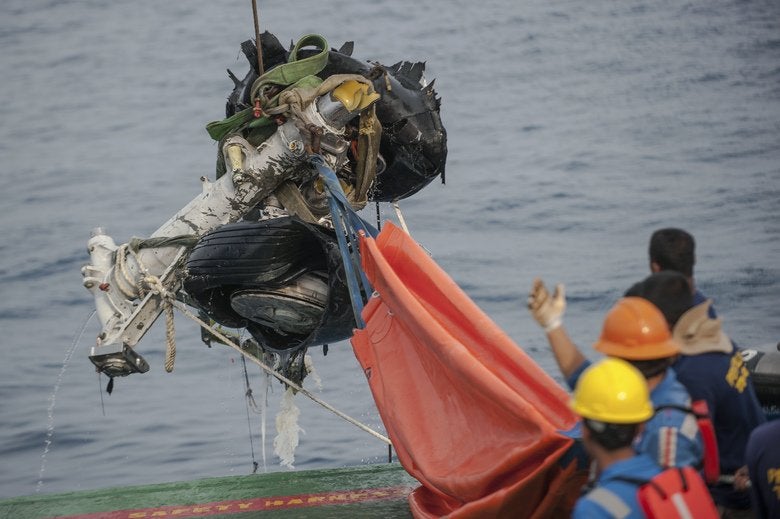
As lawsuits swirl around last month’s crash of a Lion Air 737 MAX8 into the Java Sea, Indonesian investigators say the crew struggled to control the aircraft right up to the moment of impact. And a member of Indonesia’s National Transportation Safety Committee confirmed to The Guardian that the aircraft had experienced similar problems on its previous flight.
As the aircraft pitched down, Nurcahyo Utomo of the NTSC told the Indonesian parliament Thursday, it became “increasingly difficult to control the airplane” because the load on the controls apparently became too heavy for the pilots to counter manually. The airplane crashed into the Java Sea on Oct. 29, shortly after taking off on a flight to the nearby island of Pangkal Pinang. It crashed about 11 minutes after takeoff, killing all 189 people aboard. Utomo told parliament that the aircraft’s speed at impact was more than 400 MPH.
Although it hasn’t been implicated in the crash, the post-accident investigation revealed that Boeing fitted the MAX series with an automated trim and stall-protection system called MCAS. The system activates when the airplane is being hand flown with flaps up at high angle of attack and high load factors. It automatically rolls in nose-down stabilizer trim and can be disabled only by using the airplane’s stabilizer cutout switches or lowering the flaps. It’s also inactive when the autopilot is engaged.
Boeing has been criticized by pilot unions for not clearly documenting MCAS—Maneuvering Characteristics Augmentation System—so it could be addressed in MAX differences training. Pilots at Southwest and American Airlines, both of which fly the MAX, said they were unaware of its existence.
Meanwhile, a law firm representing the families of the victims has filed a lawsuit against Boeing in a U.S. District Court claiming that the MAX series control design “in unusual conditions, can push (the plane’s nose) down unexpectedly and so strongly that flight crews can’t pull it back up.” The suit further alleges that the flight control computer was incapable of filtering inaccurate information from faulty sensors and that the approved flight manual didn’t warn pilots of these potential faults. The suit is at least the second. A Florida firm filed a suit against Boeing last week on behalf of the parents of Dr. Rio Nanda Putrama, who was killed in the crash.
Indonesia‘s NTSC said it will publish a preliminary accident report by the end of November.

