
















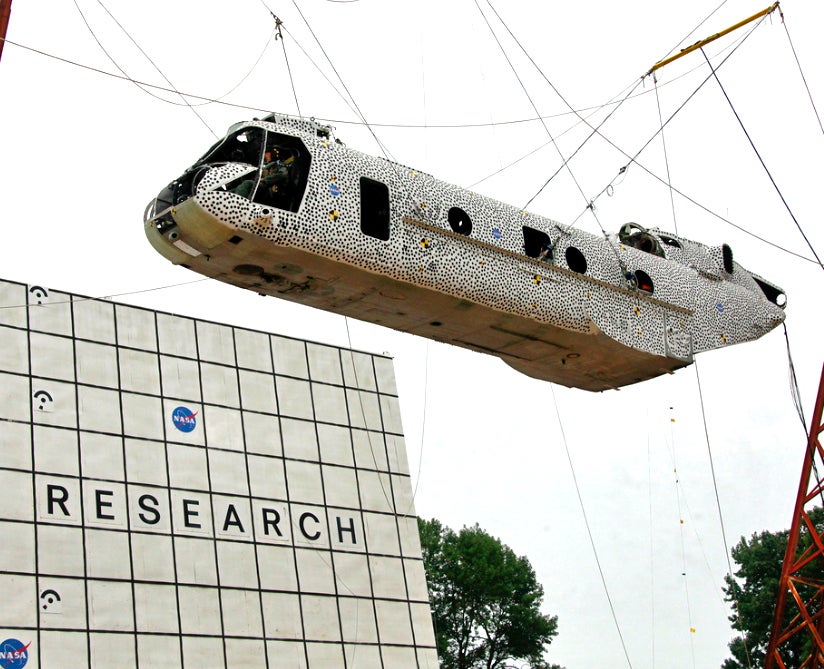
NASA announced Wednesday that it had teamed up with the U.S. Navy and the FAA to drop a CH-46E helicopter fuselage into the ground as part of an effort to improve the safety and performance of helicopters and construction techniques. A second test will take place next summer, subjecting to the same forces a CH-46E airframe modified with composite airframe retrofits. The test was observed by researchers, and also by 40 cameras (including some recording at 500 frames per second) and computers collecting data from 350 instrumentation points. The fuselage also carried 15 crash dummies to test improved seat belts and seats meant to improve helicopter crash survivability. But the test is also looking farther ahead in vertical flight development and included one NASA “first.”
NASA incorporated a video game motion sensor into the test fuselage, “to see if it is useful as an additional way to track the movements of the dummies.” Also new for the test was an external paint job of black polka dots over a white base. Each dot was used as a data point analyzed with help of the high-speed cameras. Results from the two tests will be used in NASA’s rotary wing research to aid in the development of vertical takeoff and landing vehicles of all types, and applied to enable carriage of more passengers and cargo faster, and safer, while also being more efficient and quieter. The CH-46E airframe is the same model used by Marine Helicopter Squadron One to transport the president, though the unit will be phasing in MV-22 tilt-rotor Ospreys for VIP (but not presidential) transport.NASA has made video of the test available online, here.Skip ahead to 13:10 to see the impact.

