

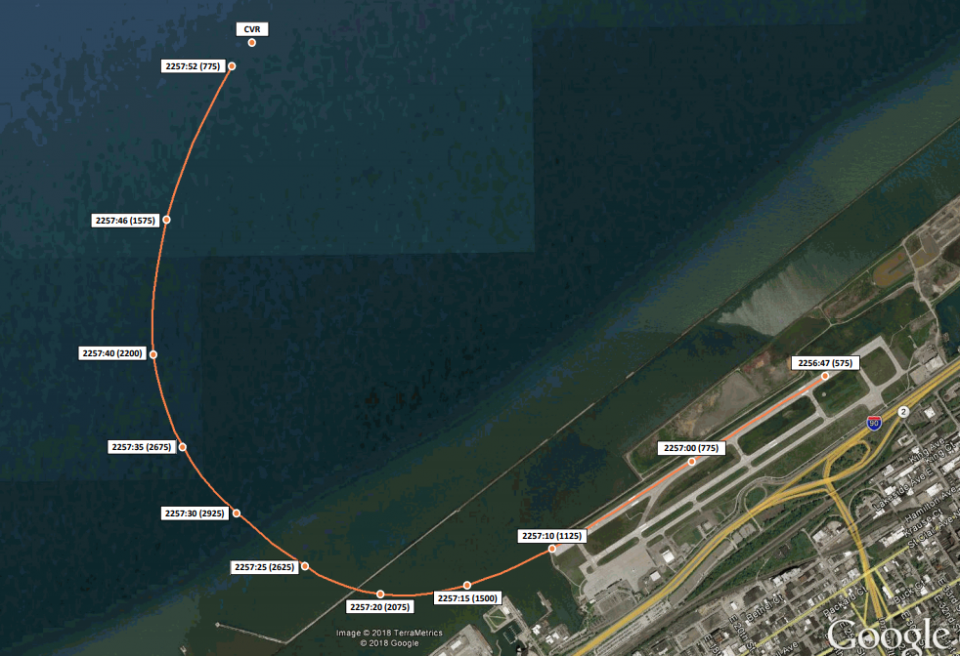
An inexperienced pilot flying on a dark night probably thought the Cessna 525’s autopilot was engaged, but it wasn’t, the NTSB has concluded in its final report on last year’s fatal crash in Lake Erie. The pilot had logged a total of 56.5 hours in Cessna 525 jets, with 8.7 hours as pilot in command, including his flight test. It’s likely the pilot attempted to engage the autopilot after takeoff, as he had been trained, the safety board said; however, based on the flight profile, the autopilot was not engaged. “This implied that the pilot failed to confirm autopilot engagement via an indication on the primary flight display,” according to the final report. “Inadequate flight instrument scanning during this time of elevated workload resulted in the pilot allowing the airplane to climb through the assigned altitude, to develop an overly steep bank angle, to continue through the assigned heading, and to ultimately enter a rapid descent without effective corrective action. A belief that the autopilot was engaged may have contributed to his lack of attention.”
The jet’s climb rate exceeded 6,000 FPM during the initial climb, the NTSB said, and it flew past the assigned altitude of 2,000 feet MSL. The flight director provided alerts before the airplane reached the assigned altitude and again after it had passed through it. The bank angle increased to about 62 degrees and the pitch attitude decreased to about 15 degrees nose down, as the airplane continued through the assigned heading. The bank angle ultimately decreased to about 25 degrees. During the subsequent descent, the airspeed and descent rate reached about 300 knots and 6,000 FPM. The enhanced ground proximity warning system provided both “bank angle” and “sink rate” alerts to the pilot, followed by seven “pull up” warnings.
The NTSB said its examination of the recovered wreckage did not reveal any anomalies consistent with a pre-impact failure or malfunction, and concluded that pilot spatial disorientation was the probable cause of the crash. “Contributing to the accident was pilot fatigue, mode confusion related to the status of the autopilot, and negative learning transfer due to flight guidance panel and attitude indicator differences from the pilot’s previous flight experience,” the board concluded. The pilot, John T. Fleming, died in the crash, along with his wife and two sons, and a neighbor and his daughter. The group was returning to Columbus, Ohio, after attending a Cleveland Cavaliers basketball game.