
















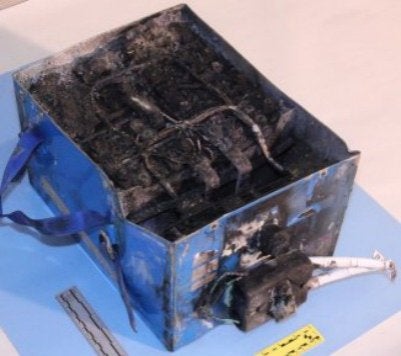
Shortcomings in design and certification ultimately led to the fire in a lithium-ion battery installed on a Boeing 787 in January 2013, the NTSB said on Monday. In the board’s final report on the incident, investigators said Boeing’s safety assessment of the battery, which was part of the data used to demonstrate FAA compliance, was insufficient. Boeing’s analysis had ruled out the possibility of cell-to-cell propagation of thermal runaway, which occurred in the fire. As a result, this potential hazard was not thoroughly scrutinized by Boeing and FAA engineers, ultimately allowing this safety hazard to go undetected during the certification process, the NTSB said. To prevent future incidents, the NTSB said the FAA should improve the guidance and training it provides to engineers for designs involving new technology.
As a result of the investigation, the NTSB made 15 safety recommendations to the FAA, two to Boeing, and one to GS Yuasa, the Japanese manufacturer of the battery. Nobody was injured in the fire, which occurred at Boston’s Logan International Airport while the airplane was parked and empty. After a second incident with an overheating battery in Japan, the 787 fleet was grounded. The airplanes were OK’d to fly in April 2013, after the FAA approved a modification to the battery system. The complete NTSB report is posted online (PDF).

