
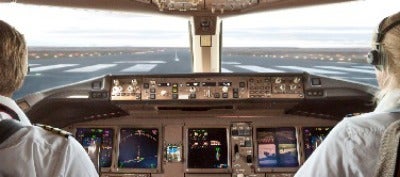
Before control of an aircraft shifts from the autopilot to the pilot, the system should require the receiving pilot to acknowledge that he or she has assumed control, according to a recent study of ergonomics and flight safety. Eric Geiselman, lead author of a two-part study published in Ergonomics in Design, emphasized that the warning should occur before the autopilot is disengaged, not after, as is currently required. “The sudden disengagement of autopilot is analogous to a pilot suddenly throwing up his or her hands and blurting to the co-pilot, ‘Your plane!'” said Geiselman. The study, which focused on two high-profile 2009 crashes — Colgan Air in Buffalo and Air France off the coast of Brazil — concluded that current autopilot design is flawed, and “creates unnecessary emergencies by surprising pilots during critical, high-workload episodes.”
Geiselman and co-authors Christopher Johnson, David Buck, and Timothy Patrick examine many other design-level safety issues in the two-article series and offer solutions they say could be affordably implemented with available technology. The authors conclude that better design of automation technology on aircraft can prevent future accidents, and more pilot training shouldn’t be the only solution pursued by the industry. The authors have combined expertise as pilots, flight instructors, crew resource management instructors, and human factors researchers. Their reports appeared in the July and October research annals published by The Human Factors and Ergonomics Society.