
















Image: Chinese Air Force
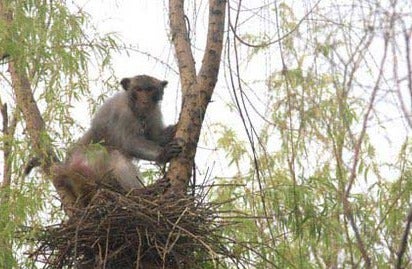
Plenty of airports are plagued by problems with birds, but at one military airport in China, officials have discovered a unique solution — they trained rhesus monkeys to climb trees near the field and knock down bird nests. “Our airfield is located along one of the eight flyways, the East Asian-Australasian Flyway, so large numbers of migrating birds come here around March every year and begin nesting near the airport, which creates significant safety hazards for flight,” said Su Chuang, head of the bird control team at an unidentified airbase of Beijing Military Command, according to China Daily. Workers have been hired in the past to knock down the nests, but it’s a slow and costly process. In the last two months, two trained monkeys have destroyed about 180 nests. The monkeys’ scent adheres to the trees, so the birds don’t return, officials said.
Compared with traditional ways of dispersing birds, the new method is eco-friendly and has a minimal effect on the birds, Wang Yuejian, commander of the airbase, told China Daily. Bird strikes are a hazard to aircraft around the world. In 2012, the FAA reported that globally, wildlife strikes have killed more than 250 people and destroyed 229 aircraft since 1988. Factors that contribute to this threat are increasing populations of large birds and more air traffic by quieter, turbofan-powered aircraft, the FAA said. Mitigation efforts in the U.S. generally involve habitat management near airports to reduce the attraction for birds, techniques for harassing hazardous species, and efforts to develop better avian radar systems.

