















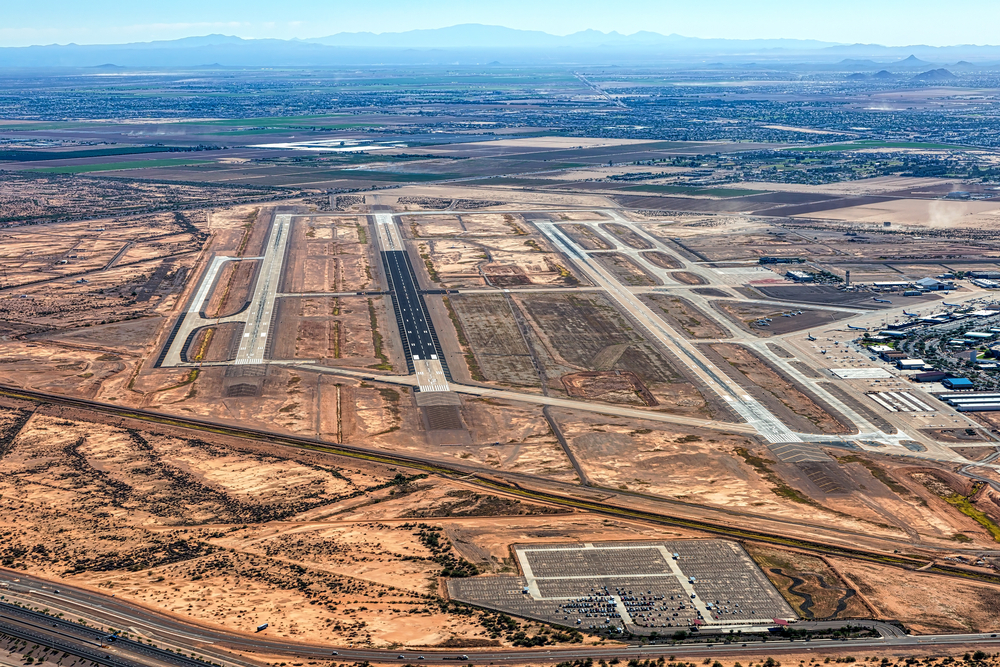

Two airport fee decisions in the Phoenix area unfolded very quickly over the last couple of weeks, and have done more than simply introduce new costs for light aircraft operators. As owners, pilots and flight schools figure out what the new fees might mean for their daily flying, a bigger, more long-term question is brewing in the background.
What happens when two of the Phoenix area’s most important general aviation and training airports decide that at least some of that activity needs to pay more directly for using the airfield?
That question is an important one for the Phoenix area, but also for the broader U.S. general aviation environment, after Mesa approved landing fees at Falcon Field, followed about a week later by Mesa Gateway announcing a fee for itinerant aircraft under 12,500 pounds.
The policies are not identical; Falcon’s reaches based aircraft as well as itinerant users, while Mesa Gateway’s applies only to itinerant traffic. Even so, together they mark a shift in how a high-volume training region may begin to think about cost recovery, capacity and growth. It is also why this story is likely less about a pair of local Phoenix-area policy changes than it is about how GA will deal with competing pressures on the whole.
As precedents around landing fees evolve, how will airports everywhere balance infrastructure demands, rising operations, strained airport finances and the role of increased training traffic in a public-use system?
Patrick Arnzen, CEO of Thrust Flight, which operates a flight school location at Falcon Field, said from his perspective the regional impact is already apparent.
“Certainly [Mesa Gateway’s new fee is] absolutely a knee-jerk reaction to what’s happened with Falcon Field, and we’re actively fighting this Falcon Field situation,” Arnzen told AVweb. He said Falcon Field’s decision to charge landing fees to based tenants is highly unusual for a general aviation airport.
At Mesa Gateway, the framing is different. Airport officials say the move reflects a longer-running financial discussion that has now intersected with changing regional dynamics.
“This is something we’ve looked at for a couple of years just because of our costs, our airfield cost center” said Ryan Smith, Mesa Gateway’s director of communications and government relations. “We’re always looking at ways to make sure that the airport can be as self-sufficient and long-term sustaining as possible.”
A shift that didn’t happen overnight
From the outside, the timing of the two decisions has felt abrupt. Mesa Gateway’s announcement came just days after Falcon Field’s approval, creating the impression of a rapid cascade.
Smith said the reality was more gradual, even if the final step came quickly.
“It wasn’t something that we necessarily had that much of a need to go be the tip of the spear and be the change agent there,” he said. “But being that the market changed and the realities of the industry changed, that’s where we started looking at it and saying, ‘If we’ve looked at this, if the market’s going to change, then we’ll look at it.’”
He was direct about what changed that Phoenix market.
“When a large airport in the region moves forward, it changes that dynamic,” Smith said. “It sort of opened the possibility for that and the ability to go and use that as a means to close that cost center. So that’s why we moved forward.”
Even so, Mesa Gateway’s approach reflects a different balance than Falcon Field’s. The airport chose to apply the new fee only to itinerant aircraft, leaving based tenants out of the structure.
“Our based aircraft here, they make that financial investment,” Smith said. “They’re paying their lease fees, they’re paying their fuel flowage fees and those kinds of things. And so that’s why we only applied it to the itinerant aircraft.”
Behind that decision is a financial picture the airport says has been developing for years. Smith described an airfield cost center that consistently runs at a deficit, even as other revenue streams have helped offset it.
“We’ve long had this deficit that we’ve dealt with and talked about,” he said. “It just hasn’t been a fire drill for us because we have other revenue sources that we’ve so far been able to tap into and utilize. But again, as the region changes and those accepted practices change, we’re looking at that.”
Where the math changes
Smith said Mesa Gateway leadership believes the airport still offers a valuable proposition for itenerate pilots and operators, even with the new fee.
“We look at it as, hey, you’re going to continue to get world-class service,” Smith said. “We try and be as competitive as possible in the areas that we need to be. And that’s your FBO-type service, your ground service, your fuel. If you’re an itinerant traveler, it’s going to be incumbent upon us to continue to provide that service and make it worthwhile.”
Smith said the decision to enact Mesa Gateway’s new fee was driven by existing financial deficits, not by any external considerations like noise complaints or the possibility of increased flight school traffic from Falcon Field. Even so, he acknowledged that where the value proposition is perhaps more likely to change is for high-volume, non-based flight school operators in the Phoenix area.
“I think where it really will affect [operators] is if you’re a flight school looking to do 300 operations in a week,” Smith said. “That’s where the math really starts to change on some of these conversations. And I think that’s where the industry needs to figure out how to best address it.”
Arnzen said that shift is already influencing how schools are thinking about where to operate, particularly those currently based at Falcon Field, where fees also apply to based aircraft.
“Every school said, ‘we’re not going to do any touch and goes here at Falcon Field at $20 a piece,’” he said. “We’re going to go to other airports. Students are concerned what this is going to do to the cost of training.”
He added that at least one school owner at Falcon Field has already indicated plans to leave.
Arnzen said his larger concern is the end state he believes the policy shift could create if more Phoenix area airports respond by trying to push training traffic elsewhere rather than absorb it.
“What’s going to happen is, it’s just going to take all the traffic that right now is spread across 20 different airports and it’s going to put it on the two airports that aren’t charging these landing fees,” he said. “So instead of having five people in the traffic pattern, we’re going to have 30 people in the traffic pattern. We’re going to have more concentrated traffic.”
That possibility of traffic shifting rather than simply disappearing from Phoenix has the ability to become a real safety concern, Arnzen suggested. It is also where the discussion begins to move beyond individual airport policies and toward regional system design.
Growth, pressure and what comes next
The Phoenix area is certainly one of the country’s busiest and most attractive environments for flight training, a position built on weather, airspace and a network of airports that, to this point, can share the load.
Smith said that success for local general aviation is part of what makes the current moment more complicated.
“We are victims of our own success,” he said. “The region owes a lot of success to this growth because of our great flying weather and the infrastructure that’s in place in all of the various airports throughout the valley.”
He added, though, that the underlying pressures on the Phoenix-area GA system that are brought by this success, particularly in the face of new fees, are unlikely to ease.
“This isn’t a problem that’s going to solve itself in the next five, 10 years,” Smith said. “It’s a problem that’s going to continue to grow … But hopefully the industry, we can get together and really talk about what are some of those options to make sure that we continue to have a safe and efficient way to do flight training and to have the amount of air traffic that we have in our valley.”
That longer horizon is one reason both sides see broader implications in what is happening now.
Arnzen argued the shift in openness to introducing landing fees for small GA aircraft could set a precedent that reaches far beyond Phoenix or Arizona.
“I think from my perspective, this sets a very dangerous precedent for every single airport in the country to look at these airports as a profit center and kill general aviation and turn it into a European model,” he said.
Arnzen also rejected the broader premise that airports should have to cover their costs the way a private business would, arguing that public-use airports serve a larger civic function.
“Last time I checked, the airports are a public utility,” Arnzen said. “The fire station’s not self-sufficient. The police station’s not self-sufficient. Parks aren’t self-sufficient.”
Smith, while not disputing the significance of the moment, described it in more incremental terms; as part of an ongoing industry conversation rather than a sudden turning point.
“It’s not a new topic, but maybe it’s a refreshed topic because of these fees passing,” he said. “It’ll be interesting to see how that unfolds industry-wide over the next six months to a year and see if other airports take notice and make changes.”
He also cautioned that some of the reactions circulating among pilots, particularly around ADS-B tracking and enforcement, risk pulling the discussion away from what he said are more constructive solutions.
“You can’t have a conversation about safety and airspace and all of that, and your response is, ‘I’m just going to turn off my transponder,’” Smith said. “I just don’t know that that’s helpful in the long run of finding a true solution that makes aviation continue to be sustainable.”
Whatever the long term outcomes for the Phoenix area and for the broader GA environment may be, we know for now that the fee structures at these two airports are scheduled to take effect May 1, and operators will adjust accordingly.
What remains less clear is how the broader system around them in the Phoenix area will respond to the landing fees—whether traffic redistributes, whether other airports follow and whether the region can maintain the balance that made it a training hub in the first place.
That is the part of the story that will take longer to unfold.


The luddites in Casa Grande started complaining about aircraft noise 40 years ago when the Lufthansa Bananas began showing up from Goodyear to use the ILS. That’s a 42nm run. Falcon is more like 30 and Gateway 20. Wait till all THOSE little birdies head down I-10 for KCGZ!
Flying is expensive enough. This just adds to it. I know that I’m not the only one who looks for cheaper options. Whether that be finding an airport with no fees to pumping my own fuel. On my cross country long distance trips, i don’t usually need a full blown FBO for just a fuel and bathroom break…
Airports that attract a student pilot population from beyond their region are net economic contributors. These students bring money from outside the region into the region and then leave when their training is complete.