
















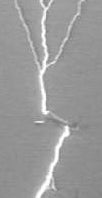
New research suggests that simply being near a lightning discharge while flying in an airplane may subject the you to the equivalent of 400 chest X-rays, or 7,500 hours of normal high-altitude flight. “Near” apparently means within about 300 yards and the potential dosage measures in at about 10 rem of exposure within less than a millisecond. “Ten rem is considered the maximum safe radiation exposure during a person’s lifetime,” according to Florida Today, which reported on the study. The bad news is that even aircraft that overfly storms aren’t necessarily avoiding the radiation generated below. The good news is that the researchers didn’t measure doses inside aircraft but estimated it based on computer models and satellite data. The better news, according to researchers, is that commercial aircraft are struck by lightning only about once or twice each year. Still, researchers do have some suggestions.
Researchers from Florida Tech worked on the project with other researchers and scientists at the University of Florida and the University of California-Santa Cruz. According to Florida Today, “they plan to recommend that the FAA place detectors aboard airplanes capable of measuring the storm-related radiation bursts to determine how often they occur.” Some forecasters are expecting an El Nino (a weather phenomena caused by warm surfaces waters in the Pacific) to produce more storms this year. That said, the preliminary research does not at this time suggest there is a newly discovered large risk to pilots and passengers.

