
















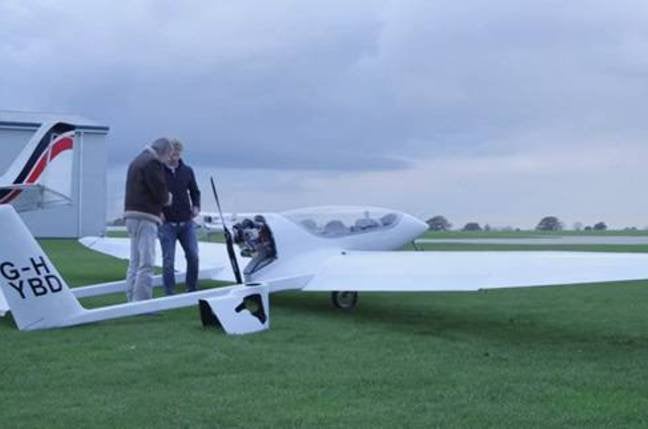
A joint effortby Cambridge University and Boeing has created a hybrid-powered version of a Czech single-seat motorglider. The aircraft is powered by a 10-kilowatt (14-horsepower) electric motor and a 7-kilowatt (10-horsepower) four-stroke gas engine that work together when lots of power is needed. The motor becomes a generator driven by the gas engine in low-power circumstances to recharge the lithium polymer batteries. Dr. Paul Robinson, of the university’s engineering department, said the aircraft is about 30 percent more fuel efficient than a gas-only version and has much better range than if it was flown on electric power alone.
Robertson said the technology is scalable so it could be used in larger aircraft and his team is also looking at alternative fuels and power sources. Although the Cambridge project has attracted some attention it’s far from the first exploration of this technology. Flight Design showed its first hybrid design in 2009 and Diamond Aircraft and Siemens flew a prototype hybrid aircraft in 2011. Several manufacturers, including Pipistrel and Flight Design, have active development projects for hybrid-powered light aircraft.

