
















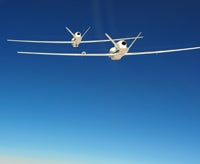
The Defense Advanced Research Projects Agency has announced that two modified Global Hawk drones have demonstrated they can “safely and autonomously operate under in-flight refueling conditions,” but challenges remain. The tests actually took place several months ago, and DARPA researchers have been poring over data acquired during those tests to reach their conclusions. Researchers expected low success rates over multiple attempts because Global Hawks are designed for endurance, not refined control authority in formation flight. But DARPA this week said data analysis shows that close formation flights show that “60 percent of the attempts would achieve contact.” And that could eventually lead to changes the mission profiles and capabilities of unmanned aerial systems.
The tests flew the aircraft in formations that kept a refueling probe and receiver at distances of 100 feet or less over hours at a time at altitudes above 44,000 feet. They applied different breakaway scenarios and contingencies and found that the aircraft successfully avoided potentially hazardous conditions. The latest tests were the ninth in a series that have advanced since 2007. In those tests, DARPA and NASA teamed to show that high-performance aircraft operated with human observer pilots could perform automated refueling from conventional manned tankers. Fitting Global Hawk aerial vehicles with air-to-air refueling capabilities would allow the aircraft to carry heavier payloads at takeoff and prolong mission times. The FAA is currently working to formalize regulations that would dictate the operation of unmanned aerial systems (UAS) in the national airspace.

