
















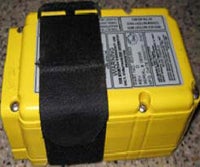
The FAA has banned the use of Velcro-type straps to secure emergency locator transmitters designed and built after Nov. 26 of this year. The new rule came two years after a high-profile crash that killed Alaska Sen. Ted Stevens and four others. The ELT aboard the Otter they were on came loose on impact and detached from the antenna. Rescuers found it on the floor in the back of plane, activated but unable to transmit because it wasn’t connected to the antenna. “In this case, the airplane was equipped with a functioning 406 megahertz ELT, which can be a tremendous aid to search and rescue operations,” NTSB Chairman Deborah Hersman said following the board’s preliminary investigation. “But this vital life-saving technology won’t do anyone any good if it doesn’t stay connected to the antenna.” The NTSB recommended the FAA review the safety standards for ELT straps and this TSO may have been the result.
ELTs approved before the new TSO can continue to be manufactured with Velcro and the FAA is not requiring aircraft owners to retrofit their ELTs, but the CEO of at least one ELT manufacturer says that given the FAA’s position it’s something that might be a future option. Mike Akatiff of ACK Avionics said in a podcast interview he’s hoping an inexpensive retrofit can be designed and approved. The new FAA rules also require 406 MHz ELTs to have a 121.5 MHz homing signal built in to further aid searchers. He said the 406 signal received by search and rescue satellites directs searchers to the immediate vicinity of the crash site and the homing signal can lead them right to the precise location. Akatiff said he also hopes the fresh look at ELTs by the FAA will revive the discussion on mandatory equipage with 406 devices, something AOPA has successfully managed to prevent so far. He said there is no question among search and rescue, military and first responders that 406 is a vastly superior technology to 121.5, and the cost of the ELTs has dropped to less than $1,000 for most new models.

