
















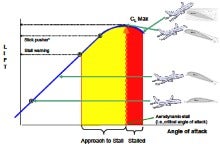
Pilots of transport-category airplanes should be taught to reduce the angle of attack as their first response to a stall warning, the FAA said on Tuesday. In a new proposed advisory circular, the FAA says it aims to provide “best practices and guidance for training, testing, and checking for pilots to ensure correct and consistent response to unexpected stall warnings, and/or stick pusher activations.” The AC is an apparent response to the Colgan Air and Air France crashes, in which the pilots’ reaction to stall warnings was part of the accident chain. Jet pilots have often been trained to use power as the initial means of recovery, to minimize altitude loss.
The AC also notes that training in stall recovery is most effective when using simulators that are as realistic as possible. If the simulator experience doesn’t duplicate reality, instructors should explain the differences, the AC says. For example, certain simulators may not be able to accurately duplicate the motion cues associated with accelerated stalls. The AC also suggests that while it’s a good idea to introduce some distractions while practicing the stall encounter, instructors are discouraged from introducing “multiple compounding malfunctions,” to avoid confusion. The FAA is accepting comments on the proposed AC until Jan. 12, via Docket No. FAA-2011-1359 at Regulations.gov.

