















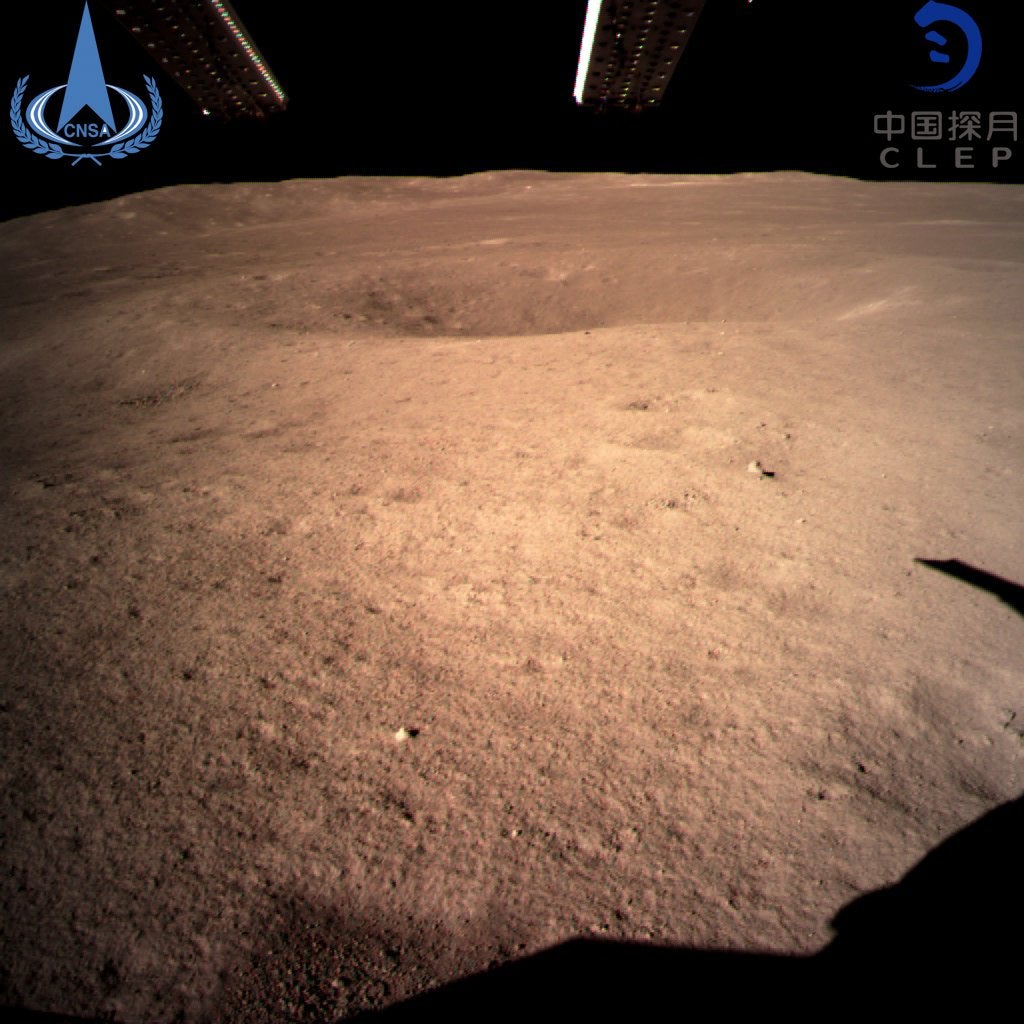


Image: CNSA
A Chinese probe has become the first spacecraft to land on the far side of the moon, according to the China National Space Administration (CNSA). CNSA says the probe, named Chang’e-4, touched down at 10:26 a.m. Beijing Time on Thursday. Chang’e-4 is an un-crewed vehicle that includes a lander and a rover.
“The Chang’e-4 probe, carrying eight payloads including two developed through international cooperation, will conduct low-frequency radio astronomical observation, survey the terrain and landforms, detect the mineral composition and shallow lunar surface structure and measure the neutron radiation and neutral atoms to study the environment on the far side of the moon,” said the CNSA. “The mission provides the world’s scientists more opportunities to explore the universe.”
Chang’e-4 was launched on Dec. 8, 2018. It landed in the Von Karman Crater in the South Pole-Aitken Basin at 177.6 degrees east longitude and 45.5 degrees south latitude. The probe, which is controlled by the Beijing Aerospace Control Center via a relay satellite, took the first close-up photo of the moon’s far side (seen above) at 11:40 a.m. The rover has not yet separated from the lander section.

