
















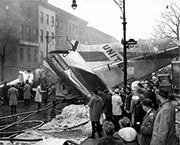
Fifty years ago, Dec. 16, the midair collision over New York City of a United Airlines DC-8 and a TWA Super Constellation became the worst aviation disaster to date; it’s since brought regulatory change and today it will be recognized, again. The crash killed 128 people on both aircraft and six more on the ground. At least 10 buildings were destroyed in Brooklyn where the DC-8 fell. The Constellation crashed down on the grounds of a military base on Staten Island. The accident has been cited as launching the first major investigation in which flight recorders were used to provide extensive insight into operations prior to the crash. It led to speed limits for aircraft operating under certain conditions and reporting rules for malfunctions of navigation or communication equipment during IFR operations. All aboard both aircraft were lost and unidentified remains were buried at Brooklyn’s Green-Wood Cemetery. The cemetery will today unveil an 8-foot granite monument in recognition of the victims.
The 1960 accident occurred in IFR conditions after controllers instructed the United DC-8 to enter a holding pattern near New York. The airliner was flying with one bad navigation radio at the time, but it is not known if that factored into the crash. Pilots testified that a beacon relevant to the holding pattern was inoperable; others said it was working. Whatever the case, the United jet overshot its hold and ultimately impacted the TWA Constellation, which was in a holding pattern nearby. Controllers might have seen the impending crash with better radar coverage, and that fact is said to have helped facilitate the addition of radar equipment at busy airports following the crash.

