
















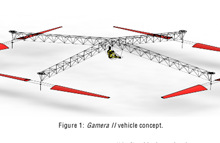
A team at the University of Maryland is currently undergoing flight tests of their improved Gamera II human-powered helicopter targeting a challenge established in 1980 by the American Helicopter Society. The team’s goal is 60 seconds of sustained flight achieving (if only momentarily) an altitude of 10 feet. They’ve already achieved 35 seconds. The Gamera project is a study in extreme engineering — if any single component is not about to break, it’s too heavy. Working toward that goal, a new “micro-truss” structural design has slashed the weight of Gamera II by 39 percent, compared to its predecessor, Gamera I. The new design is about 105 feet from tip to tip and weighs in at about 75 pounds without its 135-pound powerplant/pilot. AVweb spoke with team advisor Dr. Inderjit Chopra about the project, who offered more details. Click here to listen.
Dr. Chopra told AVweb that Gamera II incorporates improved airfoils that offer more stiffness with no weight penalty and the vehicle’s new drive system delivers more thrust with less effort. Aside from aerodynamic work, the effort has involved extensive physiological testing, yielding some interesting results. According to Dr. Chopra, Gamera’s combination of foot and hand cranks increase power output by about 20 percent. However, that gain tapers off quickly through exertion. The team has found that for flights of longer than sixty seconds, should they be possible, the addition of a hand crank does not significantly improve power output.Aside from propulsion, the pilot has no mode of control. The aircraft’s rotor blades which can be adjusted — but only when the aircraft is stationary on the ground. Because of this, and the fragility of the craft, all flight tests must be conducted indoors. If the team succeeds with its goal of a 60-second flight that momentarily achieves an altitude of 10 feet, Dr. Chopra says the next project could be a solar-powered helicopter design.

