
















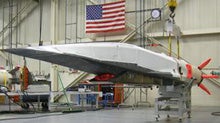
The third test of an unmanned X-51A Waverider, designed to test a scramjet engine flying at six times the speed of sound, failed Tuesday and the vehicle was lost off the coast of Southern California. Early accounts provided by the Air Force Research Laboratory at Wright-Patterson Air Force Base state that the vehicle dropped from a B-52 and was accelerated by rocket boosters, as planned. But 15 seconds after separating from its boosters, and prior to successful ignition of the scramjet, vehicle control was lost. The Air Force is blaming the failure on a faulty control fin. Previous attempts have had mixed results. One Waverider test vehicle remains.
Commenting on the latest test, a statement from the Air Force Research Laboratory said in part, “It is unfortunate that a problem with this subsystem caused a termination before we could light the scramjet engine,” The Associated Press reported. The Air Force said Wednesday that the test was flown from Edwards Air Force Base. The B-52 carried the test vehicle to 50,000 feet near Point Mugu, Calif., for release. Researchers are currently poring over data in an attempt to understand the cause of the failure. Two prior tests include a successful May 2010 flight that lasted about 143 seconds at 3,500 mph and a June 2011 test in which the scramjet was shut down due to a disruption in airflow to the engine. The Air Force has created four test vehicles within a program that Globalsecurity.org estimates has cost roughly $140 million. Officials have yet to determine when and if it will attempt to fly the program’s last vehicle at high Mach, or at all.

