
















 |
 |
| Check out AVweb reader Jean-Pierre Bonin’s gallery of photos from the ceremony on Flickr. |
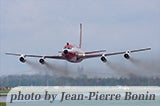
We’re not sure, but this might be the first “last flight” of an aircraft type that helped usher in the modern jet age of airliners. The last flying Boeing 720 took off from Saint-Hubert, Quebec, Canada for its presumably long-term stay at the National Air Force Museum of Canada at Royal Canadian Air Force Base Trenton, Ontario, on Wednesday. The airplane spent more than two decades as a test bed for Pratt & Whitney Canada, which mounted turboprops on the elongated nose, making it effectively the only five-engine four-engine aircraft flying. Pratt & Whitney moved to more modern Boeing 747SPs as test aircraft last year. They’re primarily engaged in testing the company’s new PurePower ultra-efficient turbofan engines.
The P&WC 720 was a 23B model built in 1961 and delivered to American Airlines. The 720 was a smaller, short-range version of the 707 and 154 were built. Pratt & Whitney Canada started using it as a test bed in 1988 and since the company makes a lot of turboprops the long nose was added as a spot to test their in-flight performance. The aircraft is officially on loan to the Trenton museum thanks to an agreement by P&WC and the Canada Aviation and Space Museum.

