

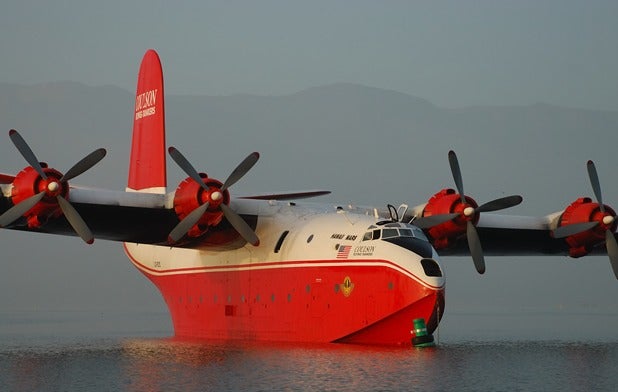
Photo: Coulson Flying Tankers
The last Martin Mars water bomber, the world’s largest piston-powered prop plane, may have fought its last fire officials said this week. The British Columbia government has cancelled a standing contract to have the aircraft available to fight fires in the province. The airplane, which can skim a lake and pick up more than 7,000 gallons of water to help fight fires, will be replaced by “a more cost-effective, efficient option,” said Steve Thomson, forests minister for British Columbia, where the aircraft has been operating for 53 years. The Mars hasn’t been used in B.C. in two years but has fought fires in the U.S. and Mexico in that time. The province hasn’t ruled out hiring the aircraft if it needs it in the future but Wayne Coulsen, who has owned two of the aircraft since 2007, told the Alberni Valley News he’s looking for alternatives, including selling the aircraft. We sent out e-mails…to some of the Red Bull folks and Virgin Air folks to see if theres any interest. We may advertise it for a time to see if we get some interest,” Coulson said. Four of the aircraft were built for the U.S. Navy as transports by Martin in the 1940s.
Coulson, head of the Coulson Group told the Victoria Times Colonist the airplanes did their job effectively and economically. “The Mars became a tool that people depended on — they felt comfort,” he said. “The Mars has been around a long time; it has stood the test of time as far as effectiveness goes.” Coulson operated two of the airplanes, which were originally built for the U.S. Navy. The airplanes are able to land on the water, scoot along “on the step” at 70 knots, and scoop up water at the rate of one ton per second, according to Coulson’s website. One of the airplanes, the Hawaii Mars, has been upgraded with a glass cockpit and the ability to stream live data from on-board systems. The sister ship, Philippine Mars, has been repainted in Navy colors in anticipation of it being sent to the Naval Aviation Museum in Pensacola, FL. That deal is in limbo, however. The airplanes require a crew of four — a captain, first officer and two flight engineers. A Smithsonian Channel documentary about the airplanes can be watched online.