
















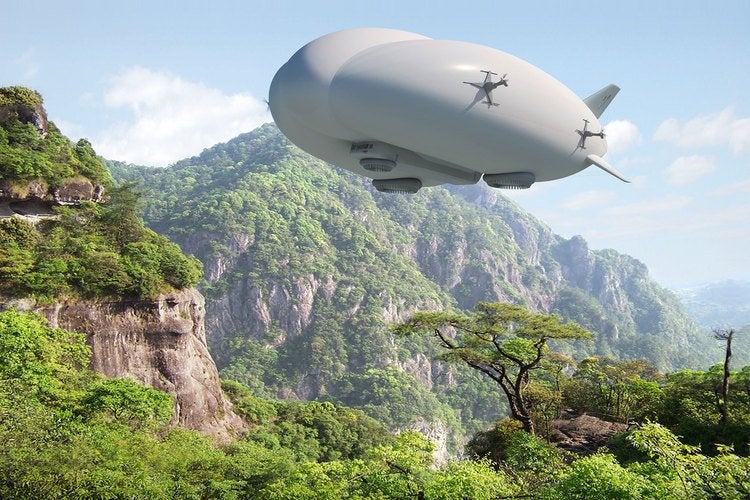
Lockheed Martin’s hybrid airship, expected to be FAA-certified in 2018, will be used to carry cargo for energy company operations around the world under a $480 million deal with British company Straightline Aviation Ltd. According to a Wall Street Journal report this week, Straightline plans to buy 12 of the 20-ton airships and market them as an economical way to take equipment and other cargo in and out of remote areas such as Alaskan oilfields. Due to dropping oil and gas prices, “there has been a great deal of interest,” a Straightline executive told the Journal.
Hybrid Enterprises LLC, which will sell the aircraft for Lockheed Martin, said production will begin at about one airship per month and could grow to four per month. The company also sees a potential need for larger vehicles that could carry 200,000 pounds, according to the Journal. Lockheed Martin’s design features an air-cushion landing system and a payload of more than 23 tons plus up to 19 passengers. The airship will have a range of 1,400 nm and a cruise speed of up to 60 knots. Straightline CEO Mike Kendrick — who had founded what is now Virgin Airship and Balloon Company — told the Journal that Straightline liked the unique landing system, which could be used on fields, snow, ice or water without ground crews. Another airship also under development, Hybrid Air Vehicle’s Airlander 10, could be a potential competitor as both designs emerged from failed military projects. So far, HAV has said it’s pursuing the passenger flight market.

