
















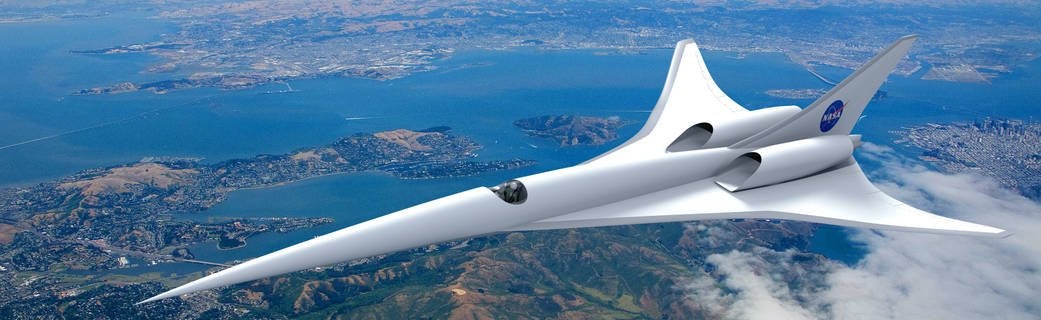
NASA said recently it will invest more than $2.3 million to support eight research projects that are working to develop quieter supersonic aircraft with fewer emissions. The support will go to the Massachusetts Institute of Technology and the University of California at Irvine, as well as several industry teams including Wyle Laboratories, Rockwell Collins and Honeywell. The researchers will investigate the impact of stratospheric supersonic aircraft on the global environment, the influence of turbulence on sonic booms, quiet-nozzle concepts that could reduce sonic booms, and more.
In a recent interview with the American Institute of Aeronautics and Astronautics, NASA’s associate administrator for the aeronautics research mission, Jaiwon Shin, said the agency’s supersonics research aims to help overcome technological barriers so private industry can move forward. “NASA has been working on technologies to develop the shape that will minimize the sonic boom intensity,” he said. “If we successfully do that, then I think there are U.S. companies that are very much interested in building supersonic airplanes.”
Growth in air travel is shifting, Shin said, with increasing interest in long routes between the Asia-Pacific region and the U.S. and Europe. “We know how long it takes to fly to Korea from here,” he said. “China alone will add about 200 million passengers between 2011 and 2016. The problem is they have to fly at least 10-plus hours to get to any place. People eventually will start demanding shorter flying time. But there are all kinds of technical barriers.”

