
















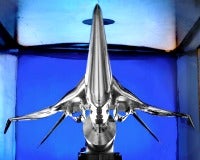
A number of technologies are in the works to solve the problem of sonic booms and resurrect commercial supersonic flight, and recently NASA tested one potential design from Boeing. Two models were tested in the supersonic wind tunnel at NASA’s Glenn Research Center in Cleveland, Ohio. The model in the photo is the larger of the two, and it’s shown upside-down. The model contains a force measurement balance used to measure forces on the model such as lift and drag. The smaller model was used to measure the off-body pressures that create a sonic boom. NASA has been funding research by Boeing and Lockheed Martin to develop designs for a small supersonic airliner that would carry between 30 and 80 passengers and potentially enter service in the 2025 timeframe.
NASA’s computer analysis has shown that a long, slender fuselage can reduce the loudness of a sonic boom; however, an 800-foot-long airliner wouldn’t be manageable with today’s airport infrastructure. “The long, skinny fuselage is not a practical answer,” said Peter Coen, NASA’s supersonic project manager at Langley Research Center in Virginia. “In our pursuit of boom reductions, we examine the whole, three-dimensional shape of the vehicle including the engine configuration.” The researchers aim to create a design that would modify the shape of the supersonic shockwaves coming off the airplane so by the time the shockwave reached the ground the sonic boom would be nearly inaudible. “The booms are still there, but your ear is tricked into hearing a thump,” Coen said. He added that while a supersonic airliner is likely a decade or two away, supersonic business jets could be flying much sooner, because lighter aircraft create weaker shock waves, making the low-boom design challenge easier to solve.

