
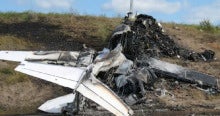
The operator of a chartered Learjet 60 failed to properly maintain its tires, starting a chain of events that ended with a deadly crash in Columbia, S.C., in September 2008, the NTSB said on Tuesday. All four of the main gear tires were severely underinflated, which compromised their integrity. The first tire failed about 1.5 seconds after the airplane reached V-1, the maximum speed at which the takeoff could be safely aborted. The captain’s decision to then attempt a high-speed rejected takeoff “went against standard operating procedures and training,” the NTSB said. Making things worse, the tire failure damaged a sensor, which caused the jet’s thrust reversers to return to the stowed position. While the captain was trying to stop the airplane by commanding reverse thrust, forward thrust was being provided at near-takeoff power because the thrust reversers were stowed, contributing to the severity of the accident. “This entirely avoidable crash should reinforce to everyone in the aviation community that there are no small maintenance items because every time a plane takes off, lives are on the line,” said NTSB Chairman Deborah Hersman.
After the airplane left the departure end of Runway 11, it struck airport lights, crashed through a perimeter fence, crossed a roadway and came to rest on a berm. The captain, the first officer, and two passengers were killed; two other passengers were seriously injured. The Safety Board also found that neither the FAA nor Learjet adequately reviewed the airplane’s design after a similar uncommanded forward thrust accident that occurred during a landing in Alabama in 2001. As a result of its investigation, the safety board made 14 recommendations to the FAA, suggesting changes in maintenance procedures, pilot training, and manufacturers’ methods of safety analysis.