
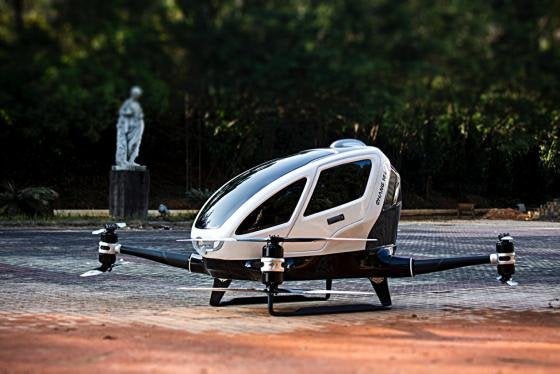
A Chinese startup company’s one-seat autonomous drone made waves this week at the Consumer Electronics Show in Las Vegas. EHang unveiled a prototype of its 184 Autonomous Aerial Vehicle, which the company says is designed for short, low-altitude commutes. The battery-powered drone, directed by a touchscreen app in the cockpit, can fly for 23 minutes at an average speed of about 54 knots, as advertised on EHang’s website. A four-arm, eight-propeller system offers redundancy along with emergency systems that will direct the drone to land if there’s a malfunction, or allow the passenger to command a landing if a problem arises.
As far as amenities, there’s 4G Wi-Fi, a reading light and air conditioning, but it can’t carry much else besides a laptop case, as its luggage space can hold just a 16-inch bag. Whether the drone can navigate complex airspace, skylines, varying terrain or obstacles isn’t clear, but EHang implies it’s ironing out such issues with plans to have “low-altitude flight command centers” that would connect to the drones online.
EHang, founded in 2014 by Huazhi Hu, also makes and sells a series of consumer quadcopters called Ghostdrone. Safety motivated Hu to start the 184 project after he lost his best friend and then his helicopter instructor to aircraft crashes. He assembled a team of friends and colleagues and, as shown in the company’s video, went from clumsy test flights of a light drone that crashed to sophisticated processes that resulted in a capable prototype. “It’s been a lifetime goal of mine to make flight faster, easier and more convenient than ever,” Hu said in the company’s announcement this week. “I truly believe that EHang will make a global impact across dozens of industries beyond personal travel.”