
















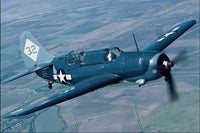
A February 2009 underwater discovery evolved Thursday into the recovery effort of an extremely rare Navy SB2C-4 Helldiver lost near San Diego 65 years ago. The aircraft was successfully raised Friday. San Diego Air and Space Museum CEO Jim Kidrick told nbcSanDiego.com the aircraft may be one of “two or three others in the world today.” (Other sources suggest there may be as many as five Helldivers in museums around the world, with one flying.) The aircraft was deposited in Lower Otay Reservoir by E.D. Frazar and his gunner Joseph Metz after it suffered engine failure during a low altitude target run on May 28, 1945. Too low to bail out, the two men survived the ditching and swam to safety. Frazar’s son Richard and other family members were on hand with hundreds of other spectators to see the aircraft pulled from the reservoir. Hundreds of volunteers now stand at the ready to work the plane back to “new” condition, but that effort will still take years and hundreds of thousands of dollars in donations. The finished product is not expected to stay in San Diego.
The aircraft was discovered last year by Duane Johnson’s fish finder. Johnson was on the lake looking for Bass but recovered pictures of the aircraft, instead. He sent the images along to the FAA and the investigation began. The National Naval Aviation Museum in Pensacola, Fla., is expected to eventually provide a static home for the aircraft following restoration. That process could take at least three years. Of roughly 2,045 SB2C-4’s built, there may be only one still flying (out of Graham, Texas).

