
















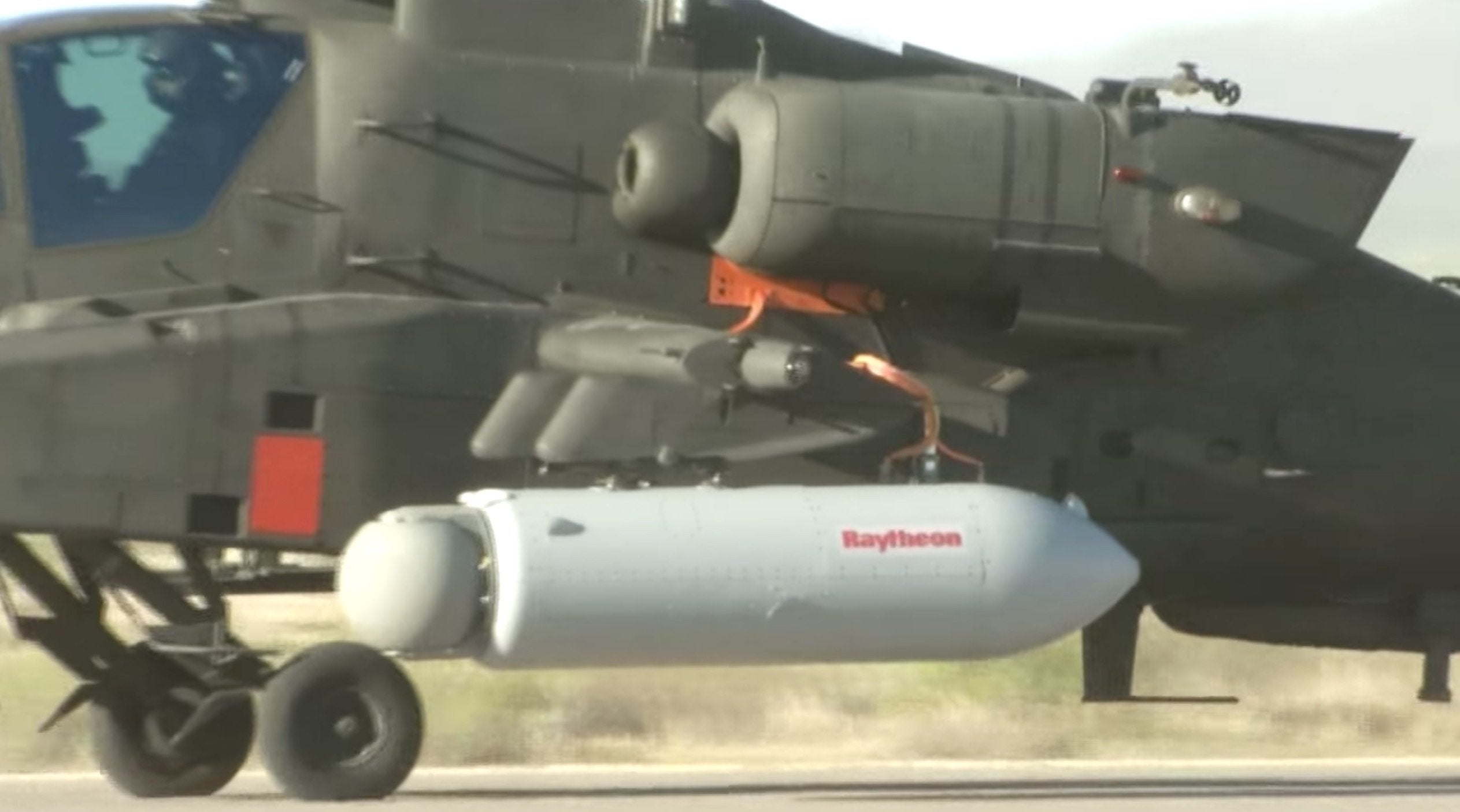
An AH-64 Apache with a pod-mounted laser was test fired on targets at the Army’s White Sands Missile Range late last week. The laser, made and tested by defense contractor Raytheon, engaged a stationary target 1.4 kilometers (slant range distance) from the helicopter. The promise of directed energy weapons is highly appealing to U.S. Special Operations Command, who collaborated with the U.S. Army Apache Program Management Office and Raytheon on the test program. Laser weapons have the capability to be incredibly accurate, produce no collateral damage outside the path of the beam (in many applications the size of a small coin) and operate at essentially zero marginal cost.
While lasers may be the future of airborne weapons, aircraft spotters probably won’t see them on operational helicopters anytime soon. Although conceptually simple, laser weapons of sufficient intensity to be useful in combat have proved challenging to power and cool anywhere other than a laboratory environment. The Raytheon laser is a research project for the development of future aircraft weapons systems, and the company offered no information on the laser’s power output. “The data collected from the test, including impact of vibration, dust and rotor downwash, will help shape future high-energy laser systems,” said Raytheon in a press release.

