
















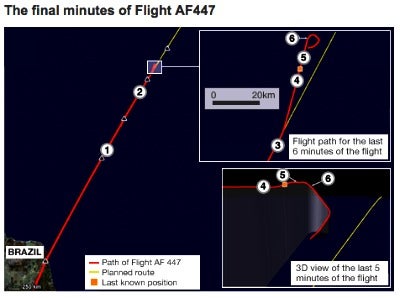
In its latest update on the Air France 447 Rio/Paris crash of June 1, 2009, the French Accident Investigation Bureau (BEA) reports on its analysis of the flight recorders, which were recovered in May. That analysis showed that after the autopilot disengaged, the pilots were confronted with a confusing situation they had never been trained for — an unreliable indicated airspeed, high altitude, and manual flight controls. Also, the report said there is no training for how to best manage cockpit resources when there are two co-pilots at the controls and a relief captain. “No standard callouts regarding the differences in pitch attitude and vertical speed were made,” the report says. In a news release, Air France said, “The combination of multiple improbable factors led to the disaster in less than four minutes … At this stage, there is no reason to question the crew’s technical skills.”
The BEA report notes that “even though they identified and announced the loss of the speed indications, neither of the two copilots called the procedure ‘Unreliable IAS’ … The copilots had received no high-altitude training for the ‘Unreliable IAS’ procedure and manual aircraft handling … No standard callouts regarding the differences in pitch attitude and vertical speed were made.” The approach to stall was characterized by the triggering of the warning, then the appearance of buffet, the report says, but “the airplane’s angle of attack was not directly displayed to the pilots.” A short time after the triggering of the stall warning, the pilot flying applied takeoff/go-around thrust and made a nose-up input. The BEA reports are available online.

