
















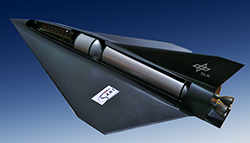
The German Aerospace Center’s Institute of Space Systems is researching a “SpaceLiner” that hopes to, by 2050, send 50 passengers from Europe to Australia in 90 minutes, flying at 24 Mach, project coordinator Martin Sippel told TechNewsDaily. The design is expected to evolve but currently includes a rocket booster that would separate from the passenger-carrying vehicle, which would cruise at an altitude of about 50 miles. According to Sippel, the concept would share similarities with the Space Shuttle because it relies on proven rocket technology and would see the vehicle glide back to earth for landing. He expects that technological advances could lure private investors to the project within the next decade. There are, of course, very large hurdles to overcome.
SpaceLiner planners currently hope to use a liquid oxygen and hydrogen rocket fuel, leaving water vapor as exhaust. They predict that advances in materials could be combined with new cooling technologies and heat shielding to safeguard the vehicle’s structures against the intense heat of hypersonic flight. Current studies and other projects are expected to yield information useful to the project. They include a European Union-funded international effort, called the Future High-Altitude High-Speed Transport 20XX (FAST20XX) project, and Project ALPHA, an Aerospace Innovation GmbH effort to launch a space plane from an Airbus A330, in flight. Even if successful, the technology may not be immediately practical. The vehicle is expected to require an isolated launch site and careful route planning to keep sonic booms from negatively affecting populated centers.

