
















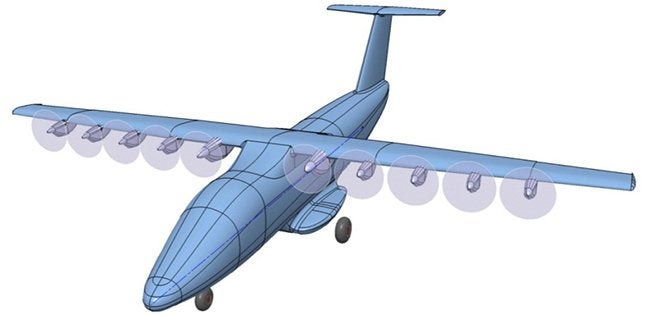
Russia has announced it’s in the race to develop an electric airliner and it’s claiming it’s ahead of other countries in the pursuit. Andrei Dutov, head of the Zhukovsky Institute National Research Center, told Russian state media that his institution is making great strides toward pure electric flight. “A 500 kW electrical engine has been developed. Next year, we hope to carry out the first flight. This is a hybrid engine. In this area, we are even outpacing such rivals as Siemens and Airbus,” the chief executive said.
There’s nothing new about hybrid drives, in which a fossil fuel engine is used to generate electricity for the motors that drive the props. The 500 kW motor is the equivalent of 670 horsepower, which is at the low end of the power spectrum for light turboprops and not typically used on anything bigger than a King Air but Dutov says it’s a stepping stone toward a 50-seat airliner. At least one concept drawing shows an aircraft with 10 engines. It looks a bit like NASA’s X-57 hybrid electric plane, which may also fly next year. Dutov said an all-electric airliner is at least 16 years away and he told Tass he expects a major technological breakthrough in about 2025 to pave the way.

