
















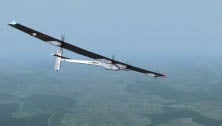
The Solar Impulse HB-SIA prototype, a uniquely solar-powered aircraft, has entered a new test phase, which should see the aircraft taking its first night flights this summer. The carbon fiber aircraft has been built with the intent to ultimately fly around the world, day and night, without fuel other than energy acquired from the sun. The new test phase follows on a successful first takeoff, last December, and will include short circuits and a first flight at altitude. Piloting the aircraft is described by the company as “an extremely difficult high-risk exercise.” Two pilots, Bertrand Piccard and Andre Borschberg, will take turns in the test series to familiarize themselves with the plane, leading to the first night flights. According to the company, “never before has such a large and lightweight aircraft left the ground.” NASA’s Helios was larger and lighter, but did not carry a human being; it broke up in flight and crashed in the Pacific Ocean in June, 2003.
The Solar Impulse is a totally new 1600-kg carbon fiber aircraft, with a 63.4-meter wingspan. It carries four electric wing motors with a maximum 10 hp each. The aircraft’s wing structure supports the motors and nearly 12,000 solar cells that feed them with renewable energy, storing any extra in 400 kg of lithium polymer batteries for night flight. The project involves specialists including engineers, air controllers and meteorologists who make up a 70-person mission team, backed by 80 partner companies. The team points out that their schedule and ambitions will ultimately be decided by technical and meteorological constraints beyond their foresight and control. The program has reached this stage following six years of work and simulation.

