
















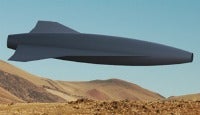
School projects don’t usually have the term supersonic cruise missile in their synopses, but engineering students at the Busemann Advanced Concepts Lab at the University of Colorado Boulder (CU) are helping to design, build and commercialize a compact jet engine designed to power supersonic unmanned aerial systems. Cruise missiles are among the potential uses for the L-FX00, which their professor Ryan Starkey calls “a high-efficiency, lubrication-free turbojet engine for unmanned aircraft” on his company website. At first, however, the class is planning to build a 110-pound airframe called the GOJETT as the first mount for the engine and hope to fly it at Mach 1.4 in 2013. The prototype will cost from $50,000 to $100,000. From there, Starkey says, the commercial and military potential is enormous.
Starkey told the Longmont Times-Call supersonic drones could be used for everything from surveillance to first response in the case of chemical or biological attack to sniff out the danger. The engine “promises reduced engine weight and higher fuel efficiency and longer time-between-overhaul than turbojet engines on the market with similar thrust output,” he claims. The project has the attention of Army, Navy, Defense Advanced Research Projects Agency and NASA, and Starkey said his new company, Starkey Aerospace, will hire CU students as the project becomes commercial.

