
















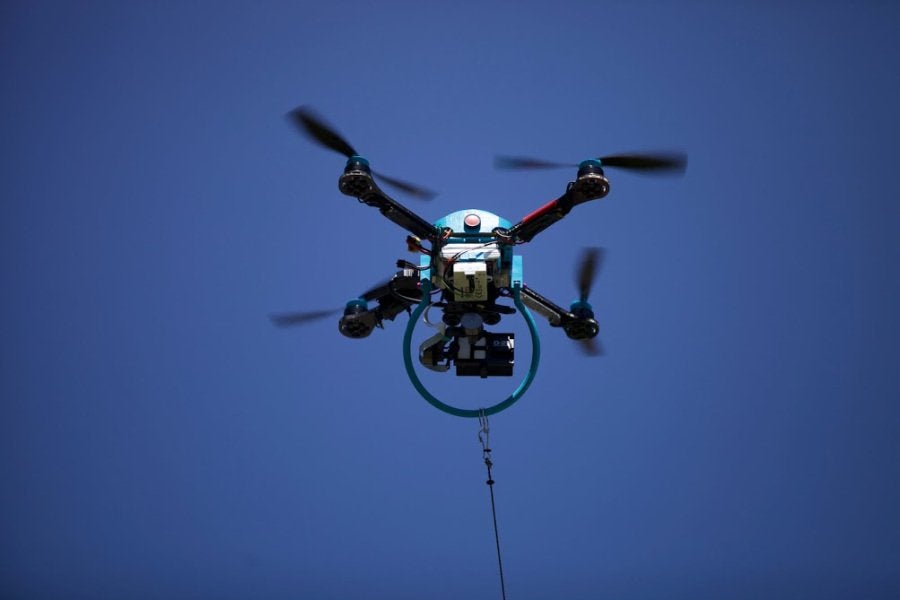
A Russian inventor has come up with a new twist on unmanned aerial systems, one that might offer a legal way around the virtual ban on their commercial use in the U.S. Sergei Lupashin’s Fotokite looks like any of the dozens of multi-copter small UAS vehicles now on the market but with an important difference.As the name implies, the Fotokite comes with a string attached and that might make it a viable and legal way for a lot of businesses to start using the technology without FAA interference. In an interview with TEDBlog, Lupashin notes that tethered devices don’t really concern the FAA. “The FAA in the U.S. (and some other authorities around the globe) typically exclude tethered vehicles from regulations and/or certification,” he said. While the tether might seem like a major operating restriction, Lupashin claims it actually offers some significant advantages over free-flying UAS designs.
Using off-the-shelf accelerometers and microprocessors, the quadcopter actually responds to tugs on the tether as commands and the line can also be used to power the device from sources on the ground to give it longer endurance. Perhaps as important is the fact that with the tether, it’s obvious who’s controlling the UAS. “You always know who is operating the vehicle and you always know if you’re safe or not,” he said. “In other words, is the machine physically capable of reaching you?” Lupashin said samples of the UAS are being tested in real-world use at the moment, particularly with journalists, and the design is being refined. He said whatever the final form of the consumer version, it will be open-source and hackable so customers can tailor it for their own uses. Although there will be no overt limitations on those uses, Lupashin said his design ethos revolves around the Fotokite being a positive influence. “We choose to pursue only what we believe can be shown to have clearly legitimate, public-interest uses,” he said.

