
















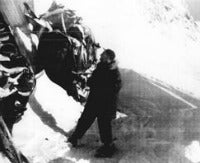
Aircraft wreckage that was discovered on a glacier last month by an Alaskan Army National Guard UH-60 Blackhawk helicopter crew on a routine training mission has been identified as an Air Force Douglas C-124A Globemaster II. The airplane crashed in November 1952, killing all 52 people on board. “The plane hit the mountainside, exploding and disintegrating upon impact,” according to an Anchorage Daily News story at the time. “Six to eight feet of powdered snow covered everything.” Military teams investigated the site shortly after the crash, but it was considered too inaccessible to attempt any recovery. After the National Guard members found the site last month, it was visited by an eight-man team from the Joint POW/MIA Accounting Command, based in Hawaii, who were able to recover some artifacts.
The team initially intended only to examine the site to provide an assessment for the follow-on recovery team, JPAC said. “Once there the team determined they could manage the recovery and began immediately. The size of the site and deteriorating environmental conditions factored into the decision,” according to JPAC’s news release. “The team recovered material evidence, such as life-support equipment from the wreckage, and also possible osseous remains [bone tissue] from the glacier. The evidence will be transported to JPAC’s Central Identification Laboratory in Hawaii for further analysis.” The wreck site is in a remote area about 45 miles east of Anchorage. The artifacts were found several miles from the original crash site, apparently traveling with the movement of the glacier.

