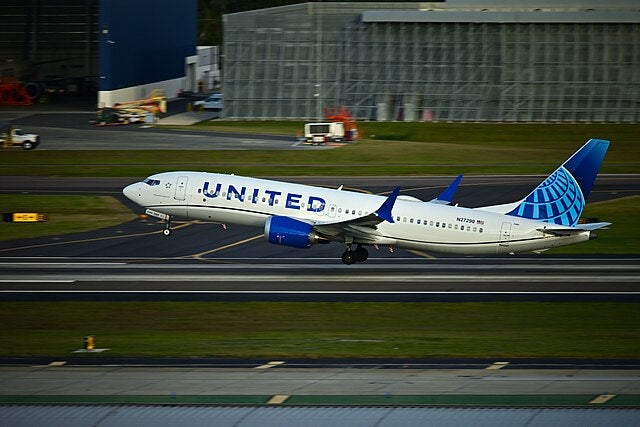

The pilots involved in a United Airlines 737 MAX 8 runway excursion on March 8 gave conflicting accounts of runway conditions, according to a preliminary report from the National Transportation Safety Board (NTSB).
The flight crew noted the captain was the pilot flying while the first officer was the pilot monitoring. The captain recalled the runway codes being 3/3/3 for Runway 26L and 26R, while Runway 27 had codes of 5/5/5. However, the NTSB noted that the surface conditions for Runway 27 were 3/3/3—indicating a slippery when wet runway and noticeably reduced braking deceleration.
The captain asked the FO to request a runway change to Runway 27, which was subsequently approved by the controller. The captain then asked the FO to request approval to roll out to the end of Runway 27, which the tower approved, but told them to “keep your speed up.” The captain changed the autobrake setting from 2 to 1—reducing the deceleration rate.
Both pilots said the aircraft broke out of the clouds at 800 to 1,000 feet MSL with good visibility. The captain perceived the runway to be dry, while the FO believed it to be wet.
The crew recalled an uneventful touchdown at an appropriate speed within the touchdown zone. According to the NTSB report, the pilot did not deactivate the speed and auto brakes until five seconds after touchdown. The captain explained that he did not “slow too much initially” because he believed the runway was dry and wanted to minimize runway occupancy while ensuring passenger comfort.
The NTSB report noted manual braking did not begin until 4,000 feet from the end of the runway. The captain became concerned when alerted of 1,000 feet remaining, prompting him to increase pressure on the brakes. Data also showed the captain decided to turn onto the taxiway while continuously pushing on the brakes.
The aircraft then veered off the runway, with the left main landing gear tires and nosewheel tires making contact with the grass before the aircraft came to a halt.
According to a report from Simple Flying, United Airlines requires pilots to adopt a conservative approach by selecting the MAX setting when uncertain about runway conditions or braking capabilities. The 1 setting is the lowest auto brake setting available to Boeing 737 pilots.