















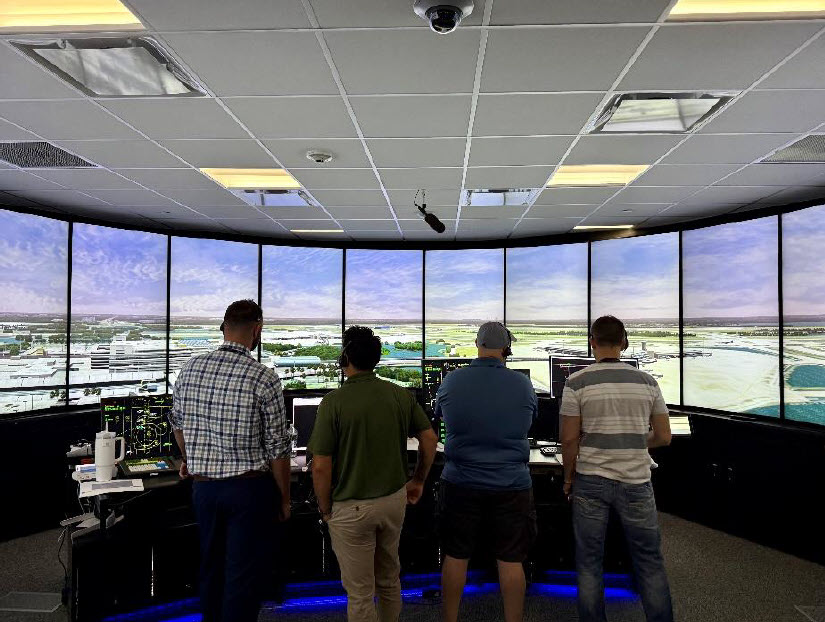

Orlando International Airport (MCO) said it conducted an Advanced Air Mobility (AAM) assessment with the Federal Aviation Administration to prepare for anticipated electric vertical takeoff and landing (eVTOL) operations. This included a three-day simulation at the FAA’s William J. Hughes Technical Center in Egg Harbor Township, New Jersey. The assessment aimed to understand how eVTOL aircraft might operate in and around the Orlando airspace. Using Human-in-the-Loop modeling and simulation, local air traffic controllers tested integration scenarios in a state-of-the-art simulated tower lab.
The airport is only the second in the country to participate in this type of assessment, which FAA officials say is an important step in integrating new entrants into the National Airspace System.
“This assessment reflects our drive to help lead the next evolution of flight,” said Lance Lyttle, CEO of the Greater Orlando Aviation Authority, in a statement. “We deeply value the collaborative partnership with the FAA, NASA, the National Air Traffic Controllers Association, and the Florida Department of Transportation as we lay the groundwork to safely bring new airspace entrants into the National Airspace System.”
The exercise builds on earlier AAM efforts at Orlando International. In November, the airport hosted a two-day tabletop exercise with federal and state partners to explore strategies for introducing eVTOL service. Airport officials say they are also considering long-term plans for AAM facilities on the east airfield and near the train station, including conceptual designs for vertiports. With more than 11,000 acres, Orlando International says it has the size and flexibility to support next-generation aviation technologies as Florida attempts to position itself at the forefront of AAM adoption.


0 replies