

















Rhode Island Airport Could Lose Its Crosswind Runway

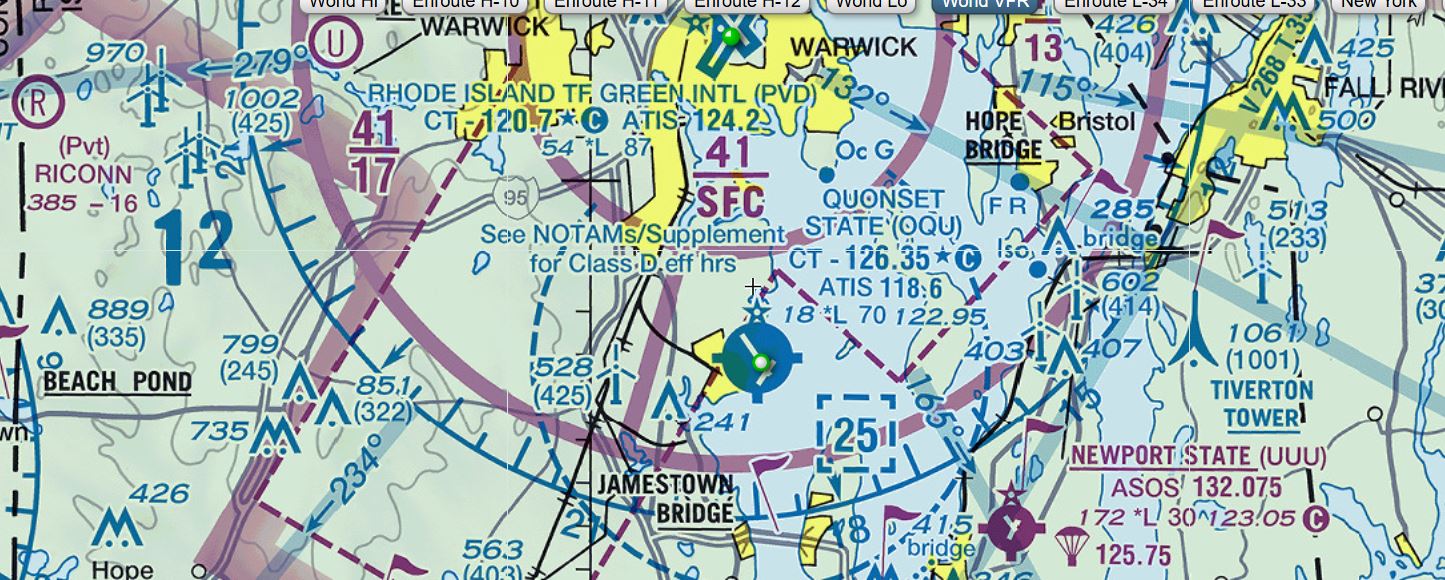
A planned Electric Boat expansion at Quonset Business Park could remove Runway 5/23 at Quonset State Airport.

FAA
Gemini Sparkle

Key Takeaways:

  • A proposed expansion by submarine builder General Dynamics Electric Boat at Quonset State Airport would remove secondary Runway 5/23 to make space for new manufacturing facilities.
  • Rhode Island pilots and aviation advocates strongly oppose the removal, citing significant safety concerns because the runway serves as a vital crosswind option, especially for light aircraft.
  • Despite opposition, the Rhode Island Airport Corporation (RIAC) has approved petitioning the FAA to advance the project, which supporters claim could create 3,000 jobs.
  • The plan now awaits final approval from the FAA, a process anticipated to take six to eight months.
See a mistake? Contact us.

A proposed expansion tied to submarine builder General Dynamics Electric Boat is drawing opposition from Rhode Island pilots and aviation advocates after plans surfaced to remove a crosswind runway at Quonset State Airport (OQU),

The airport is a joint civil-military facility serving general aviation alongside the Rhode Island Air National Guard’s 143rd Airlift Wing. FAA data show roughly 19,400 annual operations. OQU currently operates two runways: primary Runway 16/34 (7,504 ft.) and secondary Runway 5/23 (4,000 ft.).

Under the proposal, Runway 5/23 would be removed to clear space for new manufacturing facilities tied to Electric Boat’s continued expansion. According to the Providence Journal, supporters say the redevelopment could ultimately support about 3,000 jobs.

However, airport advocates including the Rhode Island Pilots Association( RIPA) are opposing the change arguing Runway 5/23 provides a safety net for pilots. Quonset’s secondary runway is still actively used—and often preferred by light aircraft—because its alignment better matches prevailing southwest winds, reducing crosswind landings that can be more challenging for smaller aircraft.

But despite those concerns, the Rhode Island Airport Corporation (RIAC) approved a plan April 9 to petition the Federal Aviation Administration (FAA) to advance the project.

RIPA President Sal Corio called the decision disappointing, saying removing a “vital runway” without a replacement crosswind option would negatively affect safety and operations. He also said the group is working with the Aircraft Owners and Pilots Association (AOPA) to oppose the change though the outlook is not promising.

Meanwhile, the plan still needs FAA approval which is expected to take about six to eight months.


Amelia Walsh

Amelia Walsh is a private pilot who enjoys flying her family’s Columbia 350. She is based in Colorado and loves all things outdoors including skiing, hiking, and camping.

Continue discussion - Visit the forum

Replies: 2

  1. The wind statistics really demonstrate how frequently the 16-34 runway is favorable to these operations. The majority of the time 5-23 is at a crosswind, making the label “crosswind runway” for 16-34 a tad ironic.

    This is an important airport for GA. It’s the only towered airport in the state besides PVD and has a Civil Air Patrol facility, the only RI airport with CAP aircraft based in it. There would be many times when CAP missions would have to be cancelled due to exceeding crosswind minimums if all they had was 16-34, and other small aircraft traffic would be greatly affected by this.

    CAP’s only other option would be to move to PVD, but that airport’s already quite busy with airline and other GA traffic, and hosts a busy flight school on top of that.

    It’s also an airport that’s in a more industrial area, with fewer NIMBYs demanding noise abatement and protesting the existence of a noisy airport in their neighborhood.

    I like Electric Boat as a company, and I think we need to find some way to accommodate them without sacrificing the cross-wind. I know it wouldn’t be a very popular suggestion for different reasons, but they could consider buying the golf course adjacent to the airport to build a job-generating facility rather than taking over part of the airport.

  2. So many things are wrong about the proposed closing of OQU/Rwy 5-23.

    1. Why is the airport sponsor (Rhode Island Airport Corp or RIAC) not actively fighting to protecting this GA runway? It is well known in RI aviation circles that RIAC only cares about the primary RI airport (PVD) and for years has done the minimum possible to maintain the surrounding GA reliever airports.
    2. I would conjecture that the proposed EB expansion is the “convenient excuse” rather than the reason for the proposed closure. There are alternative solutions for EB’s parking problems including vacant land right next to its current facility as well as a town-owned public golf course right next door. Why is a golf course considered more important than a wind-aligned GA runway? Who is to say that the proposed EB expansion is sustainable and won’t result in massive layoffs down the road?
    3. Runway 5-23 can be moved to vacant land at the North end of OQU. Why is this not being considered?
    4. RIAC is planning to SELL the runway land to the Quonset Development Corporation (QDC). Why are they selling rather than leasing the land, and what does RIAC intend to do with the money from the sale?
    5. There are other businesses that will likely expand into the runway land including J Goodson Marina which is currently occupying land that was previously slated for GA hangars. Other business being proposed include a medical waste incinerator, offshore wind turbine blade storage and a battery facility for offshore wind, and parking for new cars that come in on cargo ships. Neither RIAC nor QDC has publicly stated exactly how the plan to use the land, nor have they provided a proposed updated Airport Layout Plan (ALP).
    6. In order for OQU to remain viable as a GA airport, there needs to be dedicated space allocated for hangars, tiedowns, vehicle parking, airfield access, FBO facilities, etc.It seems RIAC only cares about the RI National Guard base and large corporate jets. In RIAC’s public comments, they refer to GA pilots as “hobbyists” and clearly do not value the impact GA has on the local community and businesses.
    7. The RIAC previously kicked nearly all GA (except a flight school) out of PVD and they told us to go to Quonset. Now they are essentially kicking us out of Quonset by making the airfield unusable to GA for flight training and and less safe to pilots inexperienced or unskilled in cross-wind operations.
    8. It seems that RIAC will use the same arguments to close runways or let airfield conditions degrade at the other RI GA airports including UUU, SFZ and WST if we let them get away with this.
    9. The RI airports should not be used as a political tool for lobbyists or as a fundraiser for politicians. These State Airports are a public resource and deserve to be properly managed by a team of aviation professionals without political conflicts of interest. Having all of the RIAC board members appointed by the RI Governor as they currently are seems to be in conflict with this goal of maintaining and preserving GA.
Sign-up for newsletters & special offers!

Get the latest stories & special offers delivered directly to your inbox

SUBSCRIBE