













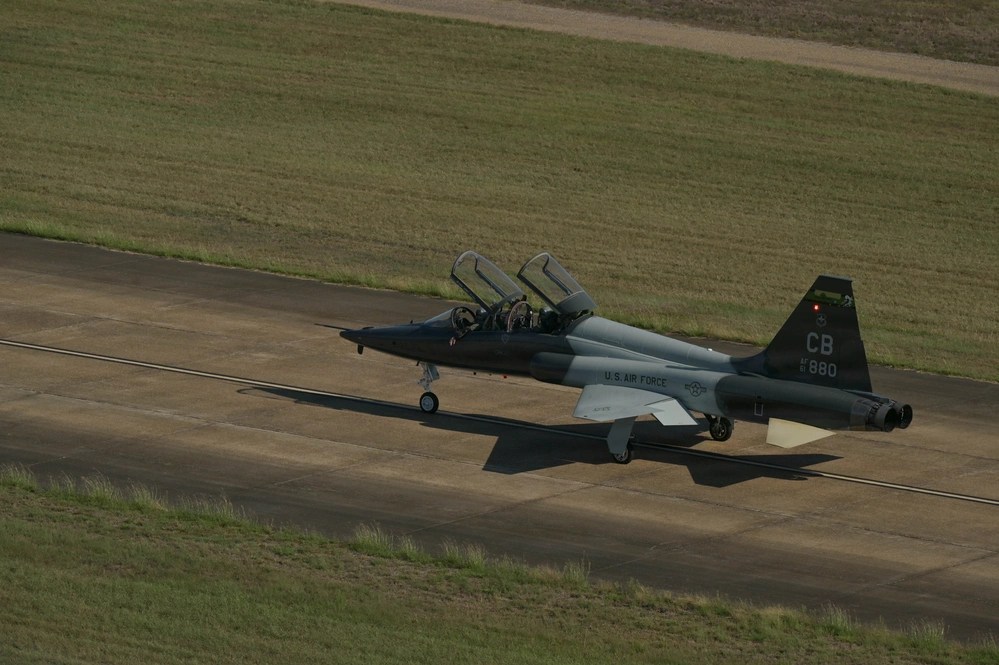

A U.S. Air Force investigation has attributed a May 12 T-38C Talon crash in Alabama to improperly secured horizontal stabilizer hardware and maintenance inspection failures. According to the investigation report, released Oct. 30, a loose actuator attachment allowed the aircraft’s horizontal stabilizers to develop aerodynamic flutter and separate during a training mission. Both pilots ejected and sustained minor injuries.
Maintenance Check Omitted
The T-38, which was assigned to Columbus Air Force Base in Mississippi, had undergone unscheduled maintenance several weeks before the accident following an uncommanded roll. Contractors discovered excessive movement in the left horizontal stabilizer actuator, which was subsequently removed, repaired, and reinstalled. Although maintenance personnel checked the stabilizers’ range of motion, investigators found they failed to perform a required backlash inspection after the actuator was reinstalled.
“The contractors signing off the actuator installation, the work center supervisor, the Impoundment Official, Quality Assurance personnel, and the Impoundment Release Authority had the opportunity and capability to identify this missing required check, but did not,” the accident investigation board president wrote.
Crew Ejects After Loss of Control
During a formation training flight that took place on May 12, the flight crew heard a loud noise and experienced severe vibrations before the aircraft entered an uncontrolled descent. Investigators determined that the loose actuator attachment allowed movement in the stabilizer system, resulting in aerodynamic flutter that eventually tore both horizontal stabilizers from the aircraft.
The instructor pilot attempted to regain control before both crew members ejected. The aircraft crashed in rural Alabama and was destroyed. Investigators found no evidence that the pilots contributed to the accident.
The accident prompted the Air Force to announce a fleetwide pause of T-38 operations on May 19. The restriction was lifted May 28 after the service developed inspection procedures for returning aircraft to flight.
The T-38 has served as an advanced jet trainer since the 1960s and is scheduled to be replaced by the T-7A Red Hawk. Under a recently approved transition plan, Sheppard Air Force Base in Texas will begin replacing its T-38C fleet in 2034.


0 replies