















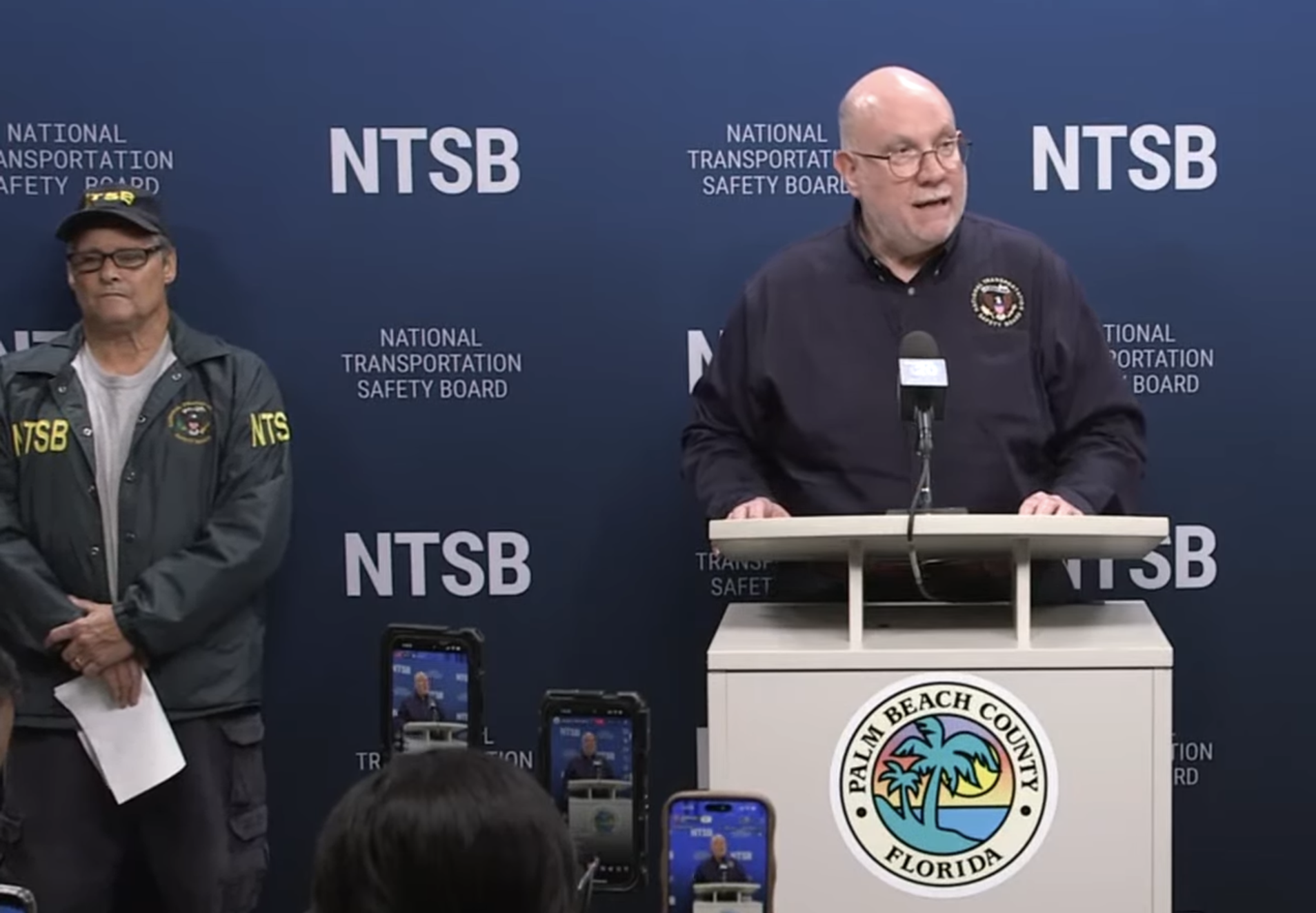

The National Transportation Safety Board said Monday that investigators have found evidence suggesting the Learjet 60 may have begun breaking apart before striking the ground in Palm Beach County, Florida, on Sunday. NTSB member Thomas B. Chapman provided the update during the agency’s first media briefing following the fatal accident, which killed all nine people aboard. Details about those individuals have not yet been released.
“We do have some evidence that there was some breakup of the aircraft before impact,” Chapman said. “We’re still seeking to determine that.”
Investigators have identified a debris field measuring approximately half a mile by four-tenths of a mile, although the precise extent remains uncertain. NTSB investigator-in-charge Timothy Monville said debris has been found near businesses, residences and recreational fields.
Investigators have not yet identified individual aircraft components or determined what, specifically, may have separated during flight.
Weather and Flight Path Under Review
Chapman confirmed that the Learjet was operating under Part 135 regulations and carried two crew members and seven passengers.
According to the NTSB, the crew reported moderate turbulence causing altitude deviations of approximately 700 feet while flying at 35,000 feet. The pilots also reported manageable clear icing and an outside temperature of minus 47 degrees Celsius. Less than 30 seconds after air traffic control approved a climb to 37,000 feet, the crew reported a rapid descent and declared an emergency.
Investigators said they have not yet determined whether the aircraft entered an active thunderstorm or what specific conditions it directly encountered at altitude. The NTSB said it is also reviewing whether a turn toward Freeport was directed by air traffic control or initiated by the crew. Chapman said those questions remain unresolved, and the agency has not established what caused the Learjet’s rapid descent.
Cockpit Voice Recorder Status Uncertain
The NTSB has not confirmed whether a cockpit voice recorder was installed onboard the Learjet at the time of the accident or whether it can be recovered.
“Our indication early here from aircraft maintenance records is that a cockpit voice recorder was installed on this aircraft,” Chapman said. “What we don’t know is whether that recorder was still on board.”
Monville said approximately 20 investigators are involved in the investigation, including specialists in aircraft structures, systems, recorders, weather and air traffic control.
Recovery efforts have been complicated by water accumulating in the impact crater, where much of the Learjet’s wreckage remains. The NTSB also confirmed that a motorist near the accident site sustained a leg injury.


That they were picking up any ice at all at FL350 makes me wonder. I understand that airline pilots try to avoid thunderheads and towering cumulonimbus by at least 20 miles, which should keep the flight in visual flight conditions. Preliminary reports have not been including mention of the high altitude involved in the icing reports, which puts any aircraft in critical airspeed realm.
Since which model Lear Jet was not mentioned; one of the original Lears, a Lear 21 may have been past its age limit. Specifically, parts break up happens on very old aircraft. Suggesting that is what happened here; especially in very cold conditions and thunderstorm conditions where the Lear is taking stress forces to its limit; and maybe beyond its limit due to age resulting in an in air aircraft breakup. Why old subsonic aircraft ages must be kept track of. To avoid the aircraft falling apart in a strenuous flight.
Terry, we know the N number from the radio transmissions. A quick Google search shows it was a Lear 60, manufactured in 2004.