

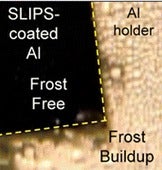
A research team from Harvard University has developed a treatment for metal surfaces that will keep them free of ice and frost, the Harvard Gazette reported on Monday. “The technology prevents ice sheets from developing on surfaces, and ice that is present slides off effortlessly,” the Gazette reports. The researchers’ new technology, called Slippery Liquid Infused Porous Surfaces (SLIPS), uses nanostructures to create an ultra-smooth, slippery surface. “This new approach to ice-phobic materials is a truly disruptive idea,” said Joanna Aizenberg, leader of the research group. “We are actively working with the refrigeration and aviation industries to bring it to market.”
Aizenberg and her team developed a way to coat metal with a rough material that locks in the lubricant. It can be applied over a large area, and it’s non-toxic and anti-corrosive. Their tests have shown that surfaces coated with the material remain “essentially frost-free” in conditions where conventional materials accumulate ice. “These results indicate that SLIPS is a promising candidate for developing robust anti-icing materials for broad applications, such as refrigeration, aviation, roofs, wires, outdoor signs, railings, and wind turbines,” the researchers said. Aircraft icing was a factor in 388 general aviation accidents between 1990 and 2000, according to AOPA’s Air Safety Foundation. Airframe icing has been on the NTSB’s “most wanted” list of safety improvements since 1997.