
















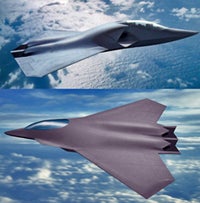
The Navy has its eyes on next-generation replacement fighter aircraft that may be needed as early as 2025 to replace the F/A-18E/F Super Hornet, and Boeing has publicly unveiled its latest design proposals. Boeing’s two twin-engine concepts are both tailless vehicles that may also be mission-capable as pilot-optional aircraft. Boeing displayed one at the Navy League Sea Air And Space Expo on May 3, as a 1/16th scale model and the latest manifestation of its F/A-XX. The design’s planform reflects that of the single-engine Phantom Ray, a stealthy unmanned tailless 50-foot-wingspan Phantom Works prototype unveiled on May 10, in St. Louis. Boeing is seeking to fill the Navy’s desire for “next generation air dominance,” after losing out on the massive Joint Strike Fighter contract won by Lockheed Martin. Decisions that would lead to the creation of technology demonstrators for the next round of aircraft may begin in late 2011 and lead to competition between prototype designs by 2013.
Programs like this not only feed the next generation of military preparedness but also keep the coals burning for Boeing, which lost out when Lockheed Martin in 2001 won its contracts for the Joint Strike Fighter. With that aircraft currently in the works and not yet operationally deployed, Boeing’s next chance to see its own fighter design contracted and operational may be at least 15 years away upon the predicted retirement of the Super Hornet. Like the Navy, the U.S. Air Force is also already looking ahead for the vehicle that will replace the F-22, which presents another opportunity for Boeing and its competitors.

