



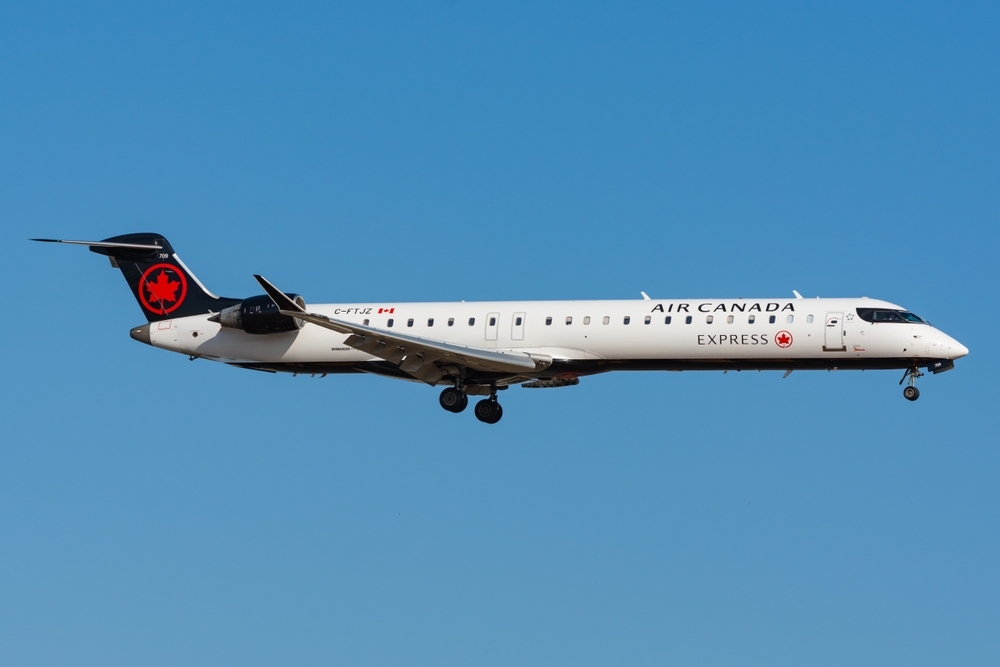

An Air Canada Express regional jet collided with a Port Authority fire truck while landing at New York’s LaGuardia Airport late Sunday, killing both pilots and injuring dozens of passengers and crew, officials said. The aircraft, a CRJ-900 operated by Jazz Aviation, had departed from Montreal and was carrying 72 passengers and four crew members. According to the Port Authority of New York and New Jersey, 41 people were taken to hospitals, with most later released, while others remained with serious injuries.
FAA Statement
— The FAA ✈️ (@FAANews) March 23, 2026
Air Canada Express Flight 8646 struck an Aircraft Rescue and Firefighting vehicle after landing on Runway 4 at LaGuardia Airport in New York. The accident occurred around 11:40 p.m. local time on Sunday, March 22. The CRJ-900 was arriving from Montreal. The FAA and…
The collision occurred at approximately 11:40 p.m. as the aircraft landed on a runway where the fire truck had been responding to a separate aircraft that reported an onboard issue. Audio recordings cited by investigators indicate the vehicle had been cleared to cross the runway, and air traffic controllers were heard instructing it to stop moments before the impact. The NTSB has launched an investigation, with support from Canadian authorities.
The FAA ordered a ground stop following the incident, closing LaGuardia until at least Monday afternoon and prompting widespread travel disruptions. More than 500 flights were canceled, with additional delays expected as airlines worked to reposition aircraft and crews.


This is misreported as a crash, but it was a collision on the ground. In aviation we generally don’t report collisions on the ground as “crashes” because “crash” evokes the idea of an airplane slamming into the ground from altitude. This was an AIR TRAFFIC CONTROL issue, again… and seems to have happened on the ground, not really a crash.
Tragic for all involved. It sounds like the controller admitted blame immediately over the air, but I would think that some responsibility rests with the truck crew. Wouldn’t you at least slow and look before entering an active runway (trust but verify)? In general the truck crew is more vulnerable in these types of collisions than the aircraft just by virtue of Newtons 2nd Law of Motion. Getting T-boned by a larger faster vehicle doesn’t end well as we saw in the Jan 2024 JAL collision with the Coast Guard DHC-8.
I concur with Bob1’s observation. A “crash” fails to communicate the monumental failure of the tower’s ground controller and approach control failures to communicate.
Can an ATCer advise why LGA delegates runway crossings to ground (obviously with coordination) instead of owning all runway surfaces and communicating directly like at LAX. I assume they are making some bottleneck vs safety choice but I don’t see any obvious reason that would justify the situational awareness gap that opened up here to this tragedy.
I believe it was the same controller talking to both the CFR vehicles and the aircraft. It’s not uncommon for one controller to be working both ground and tower positions later in the evenings when traffic is usually slower.
‘Firetruck on Runway Kills two Pilots, dozens injured’
Landing Jet slams into Firetruck on Runway’
‘Firetruck Drives into path of landing Air Canada jet’
'Firetruck crosses runway in path of landing jet ’
Avweb as a supposed trade publication with knowledgeable people should do better with your headlines.
I expect this headline on CNN or FOX , not here.
What?!? The headline I’m seeing is “Air Canada Collision at LaGuardia Kills Two Pilots
Crash shuts down major New York airport, injures dozens and disrupts hundreds of flights.”
Good point. I guess then the issue could be more saturation than locus of authority.
I departed SFO late one night…took forever to get IFR clearance from the one guy working all three positions…crazy I thought, but obviously works.
It was the “landing phase of flight”. For all we know the crew could have been attempting a last second go around. It certainly ended up in an unusual position, indicating it was still carrying a lot of speed. By your definition was the worst accident in aviation history, Tenerife, a “ground collision “. I don’t like the press, but in this case using the term crash might help, once again, to draw the public’s attention to the sorry state of our ATC system and how much it needs to be improved. It’s much more important to determine why this keeps happening rather than to nitpick about how to describe it to the general public.
Can’t disagree Cpt. I took a few minutes to see what we can figure out until we can get the real NTSB data using basic physics, and the Vref speeds and liveatc already reported elsewhere.
TDZ to Stop is about 2000 ft and an estimated over the fence speed of 140 kts,
Gathering this information from the CRJ-900 specs, and op limits took maybe 15 minutes, including the physics. We don’t know the landing weight, and actual touch down speeds or touch down zone point, and I certainly don’t know CRJ-9.
But you’re right. A publication targeted at aviation audiences could give us just a little more perspective, than say NBC or reddit.
ADSB for all ground vehicles should prevent future crashes like this.
MarsStation has the best solution: Why didn’t the truck driver look both ways before starting to cross the runway? Driving a car, I don’t trust traffic lights to prevent crossing cars from running the light. Way back 56+ years ago I was a ground controller who absently-minded cleared a friend taxiing in a Navajo to cross the runway, and he replied “I’ll wait for the traffic on short final.” His caution prevented a catastrophe from pure carelessness on my part. I also concur with the idea of requiring taxiing pilots to call on the tower local controller frequency to confirm clearance to cross a runway - wasn’t this maybe once the required practice, at least for a short time?
Physics? What physics? I don’t see any useful purpose for the couple of guesses and couple of time references you provided. Frankly, I prefer a publication targeted at aviation to remain thus targeted and leave the speculation to the websites that excel at drivel.
“Crash” is an informal term that really has no specific meaning in the aviation community. This event will be classified as an Aircraft Accident. An accident is the most serious type of event, and it is given the same classification whether it occurs on the ground or in the air. In fact, an accident can occur anytime between the time a person “boards the aircraft with the intention of flight” and the time that the last person disembarks (gate to gate). If no person is killed or seriously injured, and the damage is not “substantial,” the event would be classified as an Aircraft Incident rather than an accident.
This particular event will also be considered a Runway Incursion, and will receive extra scrutiny because the FAA and NTSB take incursions in particular very seriously. Runway incursions have been a major focal point of air traffic control training and equipment upgrades for a long time.
It’s possible that the firetruck driver didn’t see the aircraft landing so I’ll reserve judgement until the NTSB findings are released. I usually land my Maule in the grass beside a hard surface runway to save wear on my expensive bushwheels. Before I cross the hard surface runway, I stop the airplane and look both ways for landing or departing traffic. It’s hard to believe that the firetruck driver wouldn’t do the same regardless of an ATC clearance. It’s the same as crossing the street with a walk signal. You look both ways in case someone is running the red light so you don’t get killed.
Well, if analyzing statistics perhaps but try to tell survivors…
Seems to be ATC error but I’d want complete radio recordings and interviews with surviving fire fighters.
Amazing luck for the forward F/A - she was thrown 330 feet and only suffered a broken leg. While flight deck in front of her was destroyed. (Appears as though the nose over-rode the truck as it tipped over, nose mangled.)
Agree.
Haste is possible for truck driver and controller, possibly concerned about fire on another airplane.
Been there, done that too. By your post (and this horrible accident) it clearly doesn’t “work”. Somewhere in the middle - some more staff, but perhaps not full day ops - is the answer. I know up here in Canada there is “abuse” of the system by staff - guys booking off so others get overtime.
Thankyou for illuminating facts.
A big deal is being made about semantics used in the headline as to whether it was a crash from air to ground or exclusively a ground crash. Who cares? It was a fatal crash either way.
The same driver of the fire and rescue truck presumably looks both ways before crossing a street intersection when in his personal vehicle but not at an airport? All runways must be assumed to be active. Trust nothing but your eyes and ears to ensure no conflict regardless of what ATC says. An unresolved conflict can be “discussed” with the tower controller or truck-mates later. Otherwise, give it the gun and get the hell off any runway and stay off until absolutely cleared after readback of clearance without objection or correction ((basic training). Yes, it was near midnight and probably a slow traffic time, but no excuse.
A terrible accident but like so many it was preventable. In the heat of the moment and handling a declared emergency it seems the controller cleared the fire truck to cross the runway the CRJ was landing on. From the video it looks like the fire truck was crossing at a 45 degree angle from a high speed turnoff. This is the worse possible place to cross an active runway as it creates unnecessary blind spots for the driver.
Two pilot flight crews deal with blind spots with a verbal call out of “clear left” or “clear right” is this procedure trained for airport vehicle drivers? if not it should be mandatory.
Since the introduction of ADS-B aircraft on the ground and in the air are visible on a I-Pad and this technology would have clearly shown and WARNED the truck driver that a aircraft was landing on the runway that he had been cleared to cross, this would be a extremely cheap backup technology to the often overloaded and task saturated controllers at airports like LaGuardia
I recently read that over 90% of our ATC facilities are short staffed and just like the midair in DC this was probably a contributing factor. I won’t get into the political details here but the controller shortage is and was caused by political decisions.
We deserve better from our government, let’s demand it now.
Always seemed cons and pros to me as neither controller nor pilot - one person doing both is fully aware of conflicts. (Unless overworked.)
Although the tragic mishap at LaGuardia has been initially assessed with a failure of the airport alert system and no transponder in the Fire Apparatus, the mishap’s primary causal factors come down to – “human error,”
Unfortunately, the tower controller lost “situational awareness” at some point after clearing two (2) CRJ aircraft to land – both with adequate separation on final. With his statement “I messed up,” it can be hypothesized that he didn’t recall the second acft landing as he probably cleared it to land well before short final. Thus, without visually scanning the RWY for landing traffic, he mistakenly cleared the fire engine to cross RWY 4 from DELTA taxiway. Obviously, he was oblivious to the CRJ decelerating and rolling out on the RWY.
No. 1 Causal Factor - poor situational awareness by the tower controller.
Also, as a retired Naval Aviator, ATP with over 10,000 hrs., Navy mishap investigator, and airport operations executive for 17 years, the one error that I believe is most telling is the fire engine crew most likely didn’t scan the RWY to ensure it was clear before crossing RWY 4. I can’t tell you how much we stressed this to all our ground vehicle operators at my two (2) airports that when in the “movement area” always ensure the RWY is clear even if given clearance by the tower controller.
In fact, as a student Naval Aviator, I was taught this practice early on in my flight training.
While tragic, the fire crew should have been more vigilant and ensured the RWY was clear before crossing.
No. 2 - Causal Factor - the fire crew didn’t visually scan and clear the RWY before crossing.
Although we have many, many systems on the ground and in the air to aid in maintaining traffic separation and potential collision warnings, it still boils down to the human condition and our ability to maintain keen situational awareness and good spatial orientation.
Unfortunately, humans aren’t infallible and in this mishap there were two instances where human failure combined – the “dominoes were aligned” - to result in a tragic mishap.
My heart goes out to families of the two pilots, the critically injured fire crew and all the others affected by this mishap.
I can assure you I investigated numerous Navy aviation mishaps were “pilot error//human error” was the primary causal factor.
Mark Denari
CAPT USN (ret)
Yes, hard to come up with a catch all solution that prevents basic human error. I just heard the timeline of events from the NTSB. They referred to all ATC side communications as ‘Tower’ but didn’t clarify the frequency used. On earlier posts of ATC audio the controller queried ground units if they were on tower or ground so I imagine if one controller in both positions the cleared to cross would have been transmitted on Tower and Ground Freq. This would raise a very slim window (20 seconds from collision) for the landing jet to hear the Tower clear Truck 1 to cross the runway they were landing on and go-around. (Obviously asking a lot of crew 10 seconds from touchdown) If the Truck 1 request was made on tower freq that would add another 5 seconds of heads up to the pilots landing. If both the request and permission to cross were all on ground freq then the pilots had zero chance of catching the controller error. Huge “Frequency Saturation vs Situational Awareness game” no matter how you slice it, I agree.
Definitely the easiest, low-tech solution is always look before you cross a street, runway, grocery store aisle. After another’s post, though, I do wonder what that would have involved given the 45deg angle taxiway Delta intersects runway 04. The driver would have to turn their gaze 130 degrees or more. The guy riding shotgun a little more to see the approach end of the runway. Do the truck windows even have a window/clear view out that direction? It looks like Truck 1 had enough taxiway apron to stop short of runway 04 at more than a 90deg angle (facing more toward the approach end of the runway) but that’s not a normal way to cross and brings all sorts of other risks.
Jeff,
I was the Operations Director at SFO and SAN. Although I was operating a four dour sedan in the movement areas, I can assure you I always visually scanned the RWY before crossing even when authorized by tower.
Of course, it’s much easier to see when you’re perpendicular to the RWY, but we had taxiways at both airports that were 45’s which did require a little more vigilance and energy to visually inspect the RWY.
But, the practice is one that absolute should be followed. As much as our FAA personnel are trained and are outstanding in every respect, you and I know there’s always the possibility that a “human failure” could happen. Not intentional by any means, but we humans aren’t perfect.
You know, I’ve commented on the DCA mishap on several aviation websites. While the NTSB barely addressed the issue, it was clear to me that the helo pilots didn’t see the CRJ and flew into it unknowingly. FAR Part 91, subpart 131(b) explains the concept of “see and avoid” incredibly well and what responsibility the pilot has to exercise this most basic flying practice.
As an owner of the Piper PA-28-180 Archer, I can’t tell you how many times I’ve had to take evasive action to avoid another acft that drifted into my approach corridor or in the area where I do high work. I think ADSB in/out is much needed and can be helpful, but I still practice “head out of the cockpit” to see and avoid. Although my car has great mirrors and an alert system to warn me of another vehicle approaching, I still look over my shoulder when I change lanes. But, that’s what I do to remain safe.
Anyway, I appreciate your thoughtful comment.
As the days roll on, I will venture to say we’ll not get to the real crux of the mishap as investigators will cite failures in staffing, systems, politics, etc, before they come to grips with the fact that human error was the primary cause of the mishap.
Who cares? Pilots care whether it was a crash or a ground collision. Everyone loves to say wait for the NTSB to drag out a 2 year investigation before having an opinion, however it’s all on video. A ground collision that was clearly not the fault of the pilots is a tragedy, but much better for the airlines than an actual aircraft crash involving a total loss of all passengers and crew. Some are saying it’s just semantics, and while that’s probably true, it still matters how this was reported. “Another CRJ crash” is very different than, “Firetruck pulls out in front of landing aircraft killing 2”
How we report things to the general public matters because a) all the money comes from the general public, and b) all the legislation comes from senators elected by the same general public.
I’m sure the fact that it wasn’t a “crash” but a collision will be quite comforting the families of the dead pilots.
Apparently they ignored and drove over the in pavement Runways Status Lights that are bright red like a stop light. If thats the case this is full onto fire truck. The towers last line of defense for his error would have been stopping because the RSL were on a red. I venture most haven’t seen these things in operation, fully automatic, they are impressive and very easy to interpret.
When the cockpit of the aircraft involved is totally obliterated, I would definitely call that a “crash.”